
OSHA Compliant Janitorial Services: Commercial Safety Guide
What OSHA-Compliant Janitorial Services Should Cover
OSHA-compliant janitorial services start with a safe cleaning plan: keep work areas sanitary, control slip hazards, handle waste properly, and train cleaners to use chemicals and protective equipment safely. For facility managers, that means checking that a cleaning provider has accessible Safety Data Sheets, task-specific training, and a way to document work and follow up on problems. OSHA sets the worker-safety requirements; CDC cleaning guidance helps shape infection-control practices.
The right plan depends on the facility. An office, school, warehouse, and medical clinic may share basic safety needs, but each has different cleaning risks and high-touch areas.
I’m Anna Szczurek, founder of SkyLine Cleaning Enterprise in Arlington Heights, IL. Since 2007, I’ve worked with our team to build cleaning plans for commercial facilities in Arlington Heights, Chicago, and throughout Cook County and Lake County, with the safety practices behind OSHA-compliant janitorial services in mind.
Core Regulatory Standards for OSHA Compliant Janitorial Services
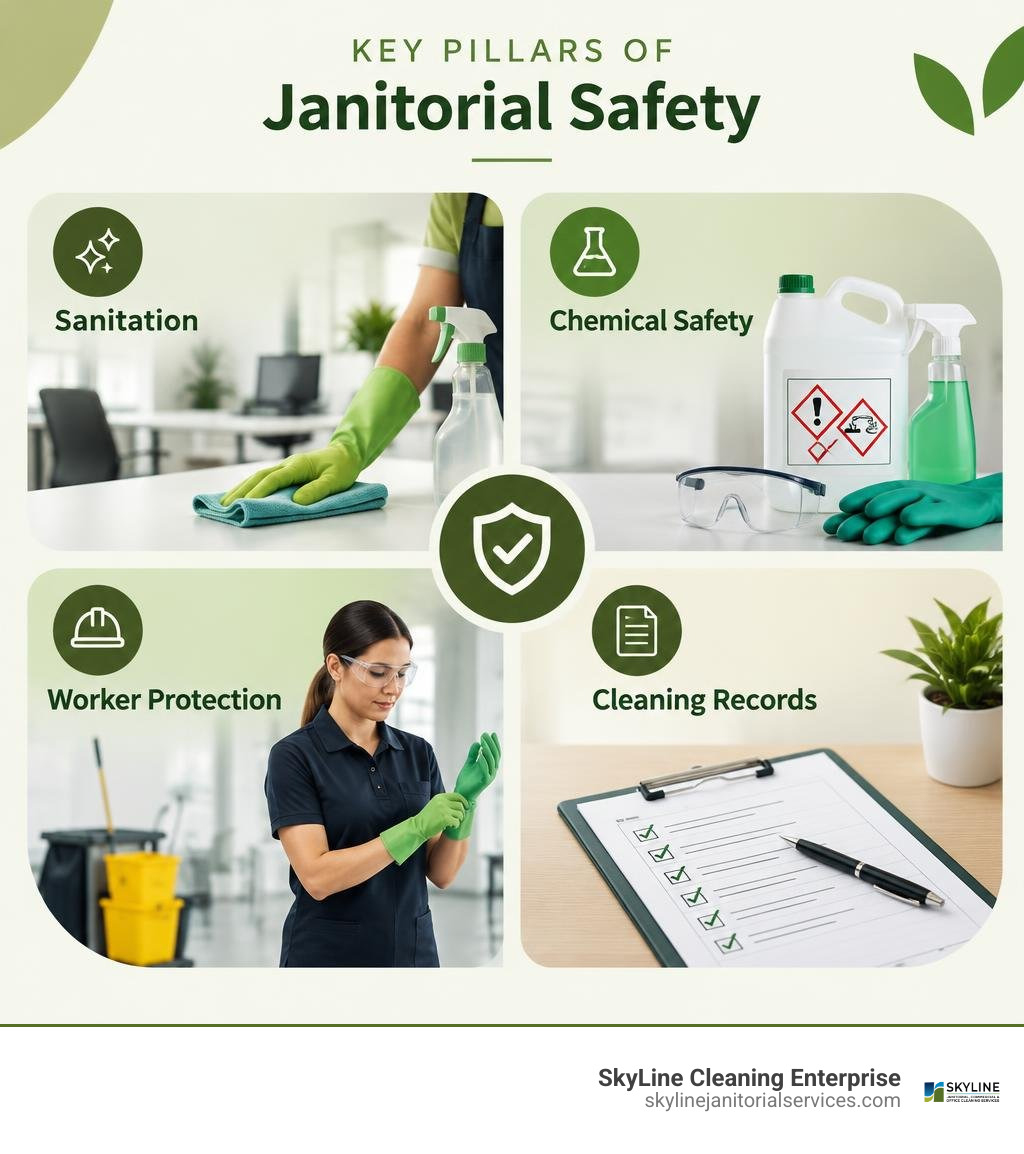
Commercial building maintenance is not just about keeping mirrors spotless and trash bins empty. At its core, commercial cleaning is an essential health and safety function governed by strict federal standards. The foundational baseline for workplace cleanliness is the Occupational Safety and Health Administration (OSHA) General Industry Standard for Sanitation, codified under 29 CFR 1910.141.

This standard establishes clear mandates for daily operational conditions. Under 29 CFR 1910.141, employers and building operators must ensure that:
- Workplaces are maintained in a clean, orderly, and sanitary condition.
- Floors remain clean and, as far as possible, dry, with adequate drainage provided where wet processes occur.
- Waste containers used for putrescible matter are constructed of leak-proof, non-absorbent materials and equipped with tight-fitting covers.
- Facilities implement a continuous pest and vermin control program.
- Employees have access to clean, potable drinking water as well as sanitary, fully stocked restroom facilities.
Meeting these baselines prevents slips, trips, falls, and biological contamination across commercial properties. Understanding these rules is simple when you review federal standards for the cleaning industry alongside practical compliance standards.
Key Safety Subparts Under 29 CFR 1910
Beyond broad sanitation, OSHA enforces specific subparts within 29 CFR 1910 that directly impact day-to-day cleaning operations. When evaluating service violations under NAICS code 561720 (Janitorial Services), OSHA citations most frequently involve these sections:
- Subpart I (Personal Protective Equipment – 29 CFR 1910.132 to 1910.138): Mandates hazard assessments and the provision of protective equipment, including eye and face protection, chemical-resistant gloves, and appropriate footwear.
- Subpart H (Hazardous Materials – 29 CFR 1910.120): Outlines procedures for handling hazardous chemicals and emergency response to spills.
- Subpart G (Occupational Health and Environmental Control – 29 CFR 1910.94): Regulates ventilation requirements during deep cleaning, stripping, or disinfecting tasks that generate vapors or airborne particles.
- Subpart F (Powered Platforms, Manlifts, and Vehicle-Mounted Work Platforms – 29 CFR 1910.66): Covers fall protection and equipment safety for elevated cleaning and window maintenance.
Aligning CDC Guidelines with OSHA Mandates
While OSHA governs physical worker safety and facility sanitation baselines, guidelines from the Centers for Disease Control and Prevention (CDC) shape effective infection control. Merging these two frameworks ensures a safe building environment:
- Cleaning: Mechanically removing dirt, debris, and impurities from surfaces using detergents and water. Cleaning reduces pathogen loads but does not kill microorganisms outright.
- Sanitizing: Lowering the number of germs on surfaces to safe levels as determined by public health standards.
- Disinfecting: Using EPA-registered chemicals to deactivate and kill specific pathogens on clean surfaces.
To be effective, disinfectants must meet specific manufacturer dwell times (contact times)—often ranging from 1 to 10 minutes—during which the surface must remain visibly wet. In busy facilities throughout Northbrook and Elk Grove Village, disciplined adherence to these dwell times protects against seasonal illness outbreaks and persistent contamination through dedicated infection control cleaning.
Hazard Communication, Chemical Safety, and Worker Protection
Cleaning chemicals can present serious health hazards if handled improperly. Under OSHA’s Hazard Communication Standard (29 CFR 1910.1200), facility teams and contracted cleaners must maintain a comprehensive chemical safety program.
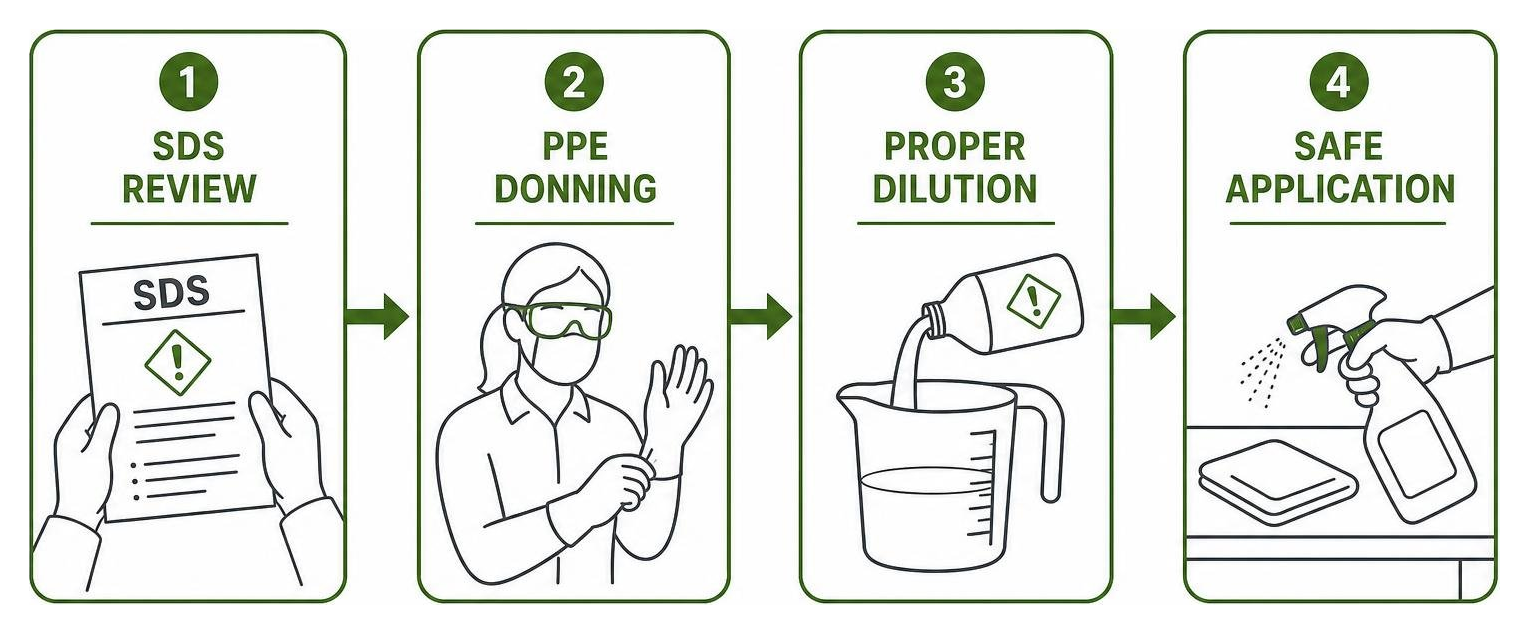
Every cleaning chemical brought onto a property must have an accessible, up-to-date Safety Data Sheet (SDS). These sheets detail health risks, proper handling, required PPE, and first-aid measures. Under the Globally Harmonized System (GHS), all primary and secondary containers—including dilution spray bottles—must feature clear pictograms, signal words, and hazard statements.
To support chemical safety, OSHA provides specialized guidance through Publication 3512 (Protecting Workers Who Use Cleaning Chemicals) and Publication 3569 (Protect Yourself: Cleaning Chemicals and Your Health). Because the cleaning industry features a diverse workforce, safety posters, chemical labels, and training programs must be provided in multilingual formats (including Spanish) to ensure every crew member thoroughly understands handling procedures.
Essential Personal Protective Equipment Programs
Personal protective equipment serves as the primary barrier against caustic cleaning agents, biological matter, and physical trauma. An OSHA-compliant cleaning operation conducts formal PPE hazard assessments before assigning tasks.
- Eye and Face Protection (29 CFR 1910.133): Splash goggles or face shields are mandatory when pouring, mixing, or diluting concentrated strippers, acids, and sanitizers.
- Hand Protection (29 CFR 1910.138): Heavy-duty nitrile or butyl gloves prevent dermatitis, chemical burns, and transdermal chemical absorption.
- Foot Protection (29 CFR 1910.136): Slip-resistant footwear helps avoid falls on slick, freshly mopped or stripped floors.
- Respiratory Protection (29 CFR 1910.134): Appropriate ventilation or particulate masks protect cleaners during tasks with heavy vapor generation or dust accumulation during commercial disinfection services.
Safe Waste Handling and Bloodborne Pathogen Protocols
Commercial cleaners occasionally encounter situations involving potential biohazards, such as bodily fluids in restrooms or sharp medical waste. OSHA’s Bloodborne Pathogens Standard (29 CFR 1910.1030) sets strict rules for handling these risks.
Cleaners must be trained in universal precautions, treating all human blood and bodily fluids as infectious. Waste handling teams must use puncture-resistant, leak-proof, color-coded biohazard bags and containers. Facilities should have dedicated cleanup kits containing absorbent powders, tongs for picking up sharps, and EPA-registered disinfectants effective against Hepatitis B, Hepatitis C, and HIV. Facility managers can review our comprehensive medical cleaning workflows for advanced biohazard protocols.
Operational Protocols for High-Touch Surface Disinfection and Facility Maintenance
High-touch points are the primary vehicles for pathogen transmission in offices, schools, and commercial facilities. Routine custodial work must systematically address door hardware, push plates, stair handrails, elevator buttons, light switches, shared breakroom appliances, and conference table surfaces.

To prevent cross-contamination across different zones, professional crews utilize color-coded microfiber systems:
- Red/Pink Microfiber: High-risk restroom areas, including toilet bowls and urinals.
- Yellow Microfiber: Low-risk restroom surfaces, such as sinks, towel dispensers, and mirrors.
- Blue Microfiber: General office areas, including desks, cubicle dividers, and reception counters.
- Green Microfiber: Breakrooms, kitchens, and food service prep surfaces.
These color-coding systems ensure that tools used on restroom fixtures are never inadvertently transferred to employee desks or dining areas. Our teams adhere strictly to these division protocols.
Maintaining OSHA Compliant Janitorial Services Across Diverse Facilities
Different commercial properties require customized safety approaches. While an office in Buffalo Grove prioritizes floor safety and indoor air quality, a healthcare clinic in Glenview requires strict sterilization routines.
| Facility Type | Primary Regulatory Concerns | Key Janitorial Safety Protocols | Critical Documentation |
|---|---|---|---|
| Corporate Offices | Slip, trip, and fall prevention; indoor air quality; chemical storage. | Wet floor signage; HEPA filtration vacuuming; GHS chemical labeling. | SDS binders; daily custodial checklist. |
| Medical Clinics | Bloodborne pathogen risks; infectious cross-contamination; bio-waste. | Color-coded microfiber; terminal cleaning; EPA List N disinfectants. | BBP training records; waste manifests; disinfection logs. |
| Warehouses & Industrial | Machine sweepers; high-volume dust; heavy chemical degreasing. | High-visibility PPE; ventilation checks; slip hazard control. | Machine inspection logs; chemical hazard plans. |
| Schools & Daycares | High-touch transmission; student chemical safety; restroom hygiene. | Restroom sanitization; secure dilution stations; toy/surface cleaning. | Chemical security logs; sanitization schedules. |
Implementing Verification, Self-Audits, and Compliance Documentation
Regulatory compliance is only as strong as its documentation. In the event of an OSHA audit or property inspection, facility managers must provide verifiable records showing consistent safety procedures.
A structured documentation system includes:
- Digital Cleaning Logs: Time-stamped records detailing when high-touch surfaces, restrooms, and common areas were sanitized.
- Inspection Checklists: Quality assurance reports completed by on-site supervisors during regular walk-throughs.
- Training Records: Documented proof of initial and annual training on Hazard Communication, Bloodborne Pathogens, and PPE handling.
- SDS Station Audits: Monthly reviews ensuring all safety data sheets match current chemical inventories in janitorial supply closets.
Strategic Benefits of Partnering with Professional Cleaning Contractors
Many facility managers find that managing in-house custodial safety requirements drains administrative resources. Partnering with an experienced, dedicated commercial contractor transfers much of this operational burden while elevating safety standards.
Professional service providers bring structured supervision, documented accountability, and commercial-grade equipment to every shift. By maintaining strict worker safety standards, contractors reduce the risk of slip-and-fall claims, chemical accidents, and worker injuries on client property.
Evaluating Professional Standards for OSHA Compliant Janitorial Services
When vetting prospective commercial cleaning contractors across Arlington Heights, Chicago, Des Plaines, Mount Prospect, or Wheeling, verify their compliance fundamentals:
- Comprehensive Insurance: Ensure the company carries General Liability, Workers’ Compensation, and commercial Auto Insurance to protect your facility from third-party liability.
- Structured Employee Training: Confirm that staff members receive regular training on OSHA standards, chemical dilution, and emergency response.
- Dedicated Supervision: Look for providers that assign field supervisors to conduct quality audits rather than leaving work unverified.
Frequently Asked Questions About OSHA Compliant Cleaning
What are the core OSHA sanitation requirements under 29 CFR 1910.141?
Under 29 CFR 1910.141, employers must maintain all work areas, passageways, and service rooms in a clean and orderly condition. Floors must be kept clean and dry, with proper drainage where wet processes occur. The standard also requires leak-proof, covered waste receptacles for putrescible trash, an active pest and vermin control program, continuous access to clean drinking water, and fully equipped, sanitary restrooms.
How often should high-touch surfaces be disinfected to meet workplace safety standards?
In standard commercial office environments, high-touch surfaces—such as door handles, light switches, handrails, and shared equipment—should be cleaned and disinfected at least once daily. In high-traffic properties, medical facilities, schools, or during known viral outbreaks, disinfection frequency should increase to multiple times per day using EPA-registered disinfectants that are allowed to sit for their full manufacturer-recommended dwell time.
What documentation is required during an OSHA compliance audit for cleaning operations?
During an audit, facilities must present readily accessible Safety Data Sheets (SDS) for all cleaning chemicals, written hazard communication and bloodborne pathogen exposure control plans, documented employee training logs, PPE hazard assessment records, and proof that secondary chemical containers are properly labeled in accordance with GHS standards.
Conclusion
Maintaining a safe, healthy workplace requires more than surface-level dusting—it demands continuous adherence to OSHA regulations, CDC guidelines, and rigorous operational standards. When building managers prioritize compliance, they protect employee health, reduce business liability, and create an inviting professional environment.
At SkyLine Cleaning Enterprise, we have delivered dependable janitorial services and specialized facility care across Cook County and Lake County since 2007. As a women-owned and family-owned business founded by Anna Szczurek, our team of 20 to 50+ trained cleaning professionals brings nearly 20 years of experience to corporate offices, healthcare centers, warehouses, and schools throughout Arlington Heights, Chicago, Northbrook, Buffalo Grove, and surrounding communities.
From VCT floor strip and wax to professional commercial carpet cleaning and day porter support, we tailor our annual service contracts to your building’s exact operational requirements. To set a high benchmark from day one, we provide new clients with a complimentary deep cleaning on the first day of service, sending an extra crew to bring the entire facility up to our meticulous standard. We are fully insured with General Liability, Workers’ Compensation, and Auto Insurance, and our office is open Monday through Sunday from 8:00 AM to 5:00 PM.
If you are ready to upgrade your facility’s safety standards, contact us today to request an individualized cleaning plan and quote for your property.