
A Practical Guide to Compliance & Standards
Why Compliance & Standards in Commercial Cleaning Matter for Your Facility
Compliance & Standards in Commercial Cleaning cover a set of federal regulations, industry certifications, and documentation requirements that every commercial cleaning operation must meet to protect workers, building occupants, and facility owners.
Here is a quick overview of the key frameworks:
| Framework | Who Sets It | What It Covers |
|---|---|---|
| OSHA 29 CFR 1910 | Federal government | Worker safety, PPE, chemical hazards, fall prevention |
| EPA / FIFRA | Federal government | Disinfectant registration, chemical use and disposal |
| Green Seal GS-42 | Nonprofit (Green Seal) | Green cleaning operations, training, purchasing |
| ISSA Clean Standard | Industry association (ISSA) | ATP testing, cleaning effectiveness measurement |
| CIMS | Industry association (ISSA) | Quality management, service consistency |
| APPA Levels | Education/facility association | Five-tier cleanliness benchmarking |
Compliance failures rarely give advance warning. They surface during an inspection, after a workplace injury, or when a vendor cannot produce a Safety Data Sheet on request. For facility managers in Arlington Heights and Chicago, the stakes are real — a single OSHA inspection identifying multiple serious violations can expose a facility to more than $100,000 in penalties.
This guide breaks down every major standard and regulation you need to know, from OSHA hazard communication rules to Green Seal certification requirements, so you can evaluate your cleaning program with confidence.
I’m Anna Szczurek, founder of SkyLine Cleaning Enterprise Co. — before starting SkyLine in 2007, I managed compliance and operations across more than 100 commercial facilities as an Account Executive for a large cleaning company, which gave me a understanding of how Compliance & Standards in Commercial Cleaning directly affect facility safety and vendor accountability. That experience is the foundation of how SkyLine approaches every client relationship across Arlington Heights, Chicago, and the surrounding suburbs today.

The Core Regulatory Framework: Compliance & Standards in Commercial Cleaning
Operating a safe commercial facility requires a clear understanding of federal and local oversight. When it comes to cleaning, regulatory compliance is not just about keeping surfaces looking polished; it is about establishing systematic safety protocols that protect your staff, our cleaning crews, and the structural integrity of your building.
OSHA Requirements for Compliance & Standards in Commercial Cleaning
The Occupational Safety and Health Administration (OSHA) enforces strict guidelines under the General Industry Standards (29 CFR 1910) that apply directly to janitorial services. According to historical citation data, employers in NAICS code 561720 (janitorial services) are cited most frequently for failures in hazard communication, fall protection, and respiratory protection.
To maintain compliance, we focus on several primary OSHA standards:
- Hazard Communication (29 CFR 1910.1200): Often referred to as “HazCom,” this is the single most-cited standard in the cleaning industry. It requires employers to maintain a written hazard communication program, keep updated Safety Data Sheets (SDSs) accessible to all shifts, and ensure every chemical container is properly labeled. In 2024, OSHA updated HazCom with staggered compliance deadlines running through 2028. Specifically, the deadline for substance labels was May 19, 2026, and the deadline for employer programs covering those substances is November 20, 2026.
- Personal Protective Equipment (29 CFR 1910.132): Cleaning crews must be provided with, trained on, and required to wear appropriate PPE—such as chemical-resistant gloves, eye protection, and non-slip footwear—based on the specific tasks they perform.
- Walking-Working Surfaces (29 CFR 1910.22): This standard mandates that all workplace floors be kept clean, orderly, and, as far as possible, dry. For commercial cleaning, this means deploying wet floor signage before mopping and keeping those signs in place until the floor is completely dry.
- Respiratory Protection (29 CFR 1910.134): If cleaners handle highly concentrated chemicals or work in environments with airborne particulates (such as post-construction cleanups), proper respiratory protection programs and fit-testing are required.
- Bloodborne Pathogens (29 CFR 1910.1030): This standard requires specialized exposure control plans, training, and disposal protocols for any cleaning tasks that involve potential exposure to blood or other potentially infectious materials (OPIM), which is highly relevant in medical facility cleaning.
- Sanitation (29 CFR 1910.141): This outlines the baseline requirements for waste disposal, water supply, and restroom cleanliness to prevent biological hazards.
To learn more about how federal agencies regulate safety in this sector, you can review the OSHA Cleaning Industry Overview. Understanding these rules helps clarify what janitorial services include when performed by a professional, fully regulated provider.
EPA Chemical Regulations and Disinfectant Standards
The Environmental Protection Agency (EPA) regulates the chemical formulations used to sanitize and disinfect commercial spaces. Under the Federal Insecticide, Fungicide, and Rodenticide Act (FIFRA), any product that makes antimicrobial claims (such as “kills 99.9% of bacteria”) must be registered with the EPA and display an official registration number on its label (formatted as “EPA Reg. No. XXXX-XX”).
To ensure compliance with EPA guidelines:
- Dwell Time Adherence: Disinfectants must be applied exactly as directed by the label, paying close attention to the required “dwell time” (the amount of time a surface must remain visibly wet to kill the targeted pathogens).
- Secondary Container Labeling: If a concentrated chemical is diluted into a secondary spray bottle, that bottle must carry a compliant label identifying the chemical name, manufacturer, and key hazard warnings matching the original SDS.
- Chemical Disposal: Expired chemicals and packaging must be disposed of in accordance with local environmental regulations and the product’s SDS to prevent hazardous runoff.
For specialty environments, products must meet strict toxicological and environmental benchmarks. For example, standards like the Green Seal GS-53 Standard for Specialty Cleaning Products outline strict limits on volatile organic compounds (VOCs), aquatic biodegradability (requiring organic components to achieve >70% dissolved organic carbon removal within 28 days), and prohibit toxic ingredients like phthalates or PFAS.
While navigating these chemical regulations, many Chicago-area facilities choose to align their operations with local environmental guidelines, which you can read about in our Eco-Friendly Cleaning Chicago Guide 2026.
Industry Certifications and Cleanliness Benchmarks
While federal regulations set the legal floor for safety, voluntary industry certifications and benchmarks establish the ceiling for operational quality and consistency.
Green Seal GS-42 Standards for Commercial Facilities
The Green Seal GS-42 standard is a rigorous, lifecycle-based certification for commercial and institutional cleaning services. It focuses on reducing the environmental and health impacts of cleaning operations while protecting vulnerable building occupants.
Key requirements of the Green Seal GS-42 Standard include:
- Building-Specific Cleaning Plans: Certified services must maintain a written standard operating procedure (SOP) and a customized cleaning plan for each building. This plan must be reviewed at least once a year, with schedules reviewed and adjusted twice a year.
- Rigorous Staff Training: New hires must complete at least 12 hours of initial training upon hiring, plus an additional 12 hours of training before the end of their first year. Continuing employees must receive at least 24 hours of training annually.
- Equipment Specifications: Powered cleaning equipment must meet strict performance and acoustic standards. For example, vacuum cleaners must operate below 70 dBA and meet the Carpet and Rug Institute (CRI) Green Label program requirements to protect indoor air quality.
- Operational Controls: Carpet extraction must be scheduled during low-occupancy hours and must allow carpets to dry in less than 12 hours to prevent mold growth. Entryway matting must consist of 6 to 10 feet of scraper/wiper matting followed by 6 to 10 feet of wiper matting to trap soil at the door.
To explore these standards in detail, you can read the official GS-42 Commercial and Institutional Cleaning Services Standard page, or consult our Best Janitorial Services Guide 2025 to see how these benchmarks elevate daily service quality.
The ISSA Clean Standard and Objective ATP Testing
To move away from purely subjective “looks clean” assessments, the ISSA Clean Standard provides a scientific framework for measuring cleaning effectiveness. This standard relies heavily on Adenosine Triphosphate (ATP) testing alongside traditional visual audits.
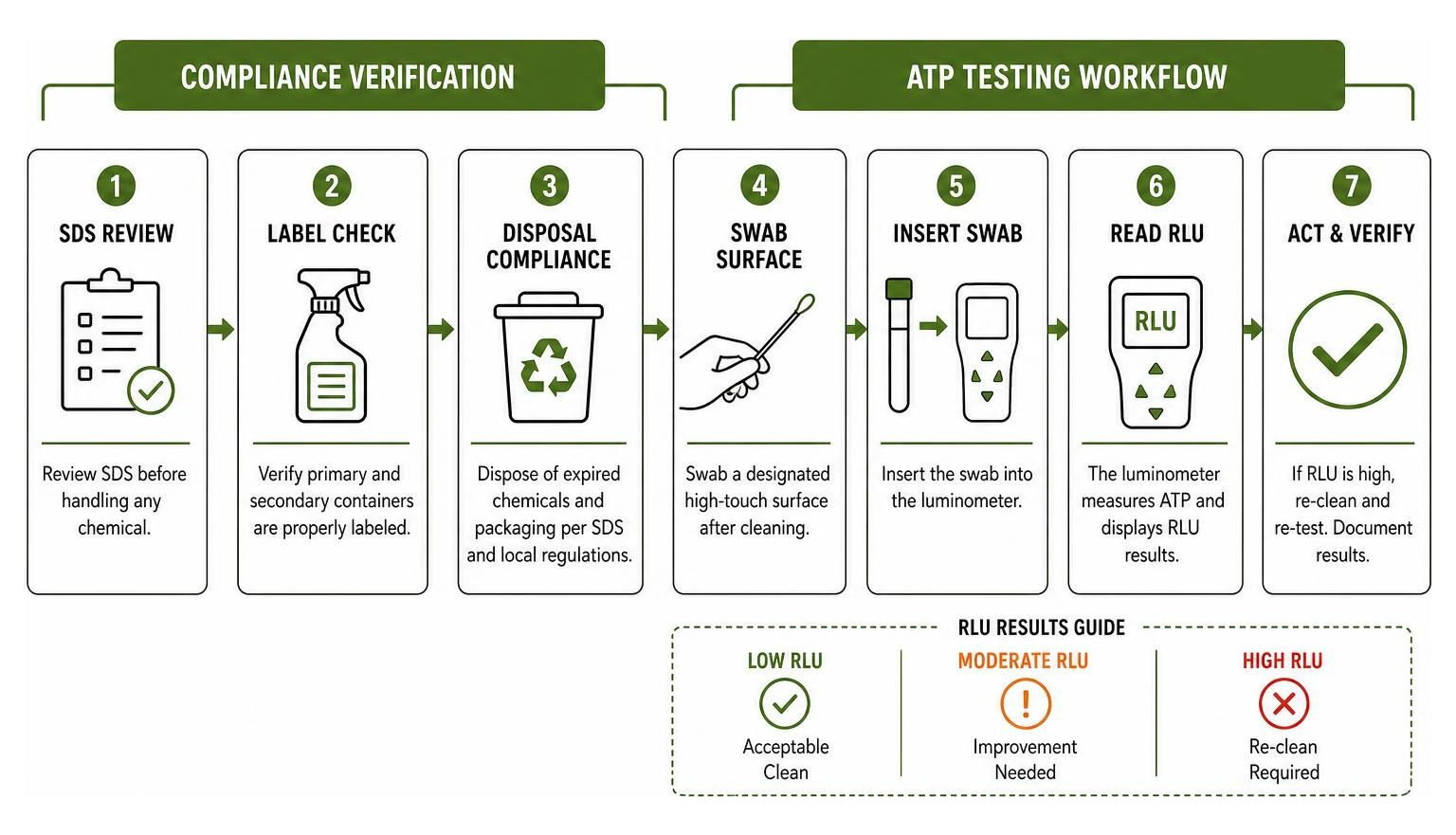
ATP is an energy molecule found in all animal, plant, bacterial, yeast, and mold cells. Its presence on a surface indicates organic residue. ATP testing works by using a specialized swab and a luminometer:
- The cleaning team swabs a designated high-touch surface (such as a light switch, door handle, or restroom faucet).
- The swab is placed in the luminometer, which measures the biological energy on the surface in Relative Light Units (RLUs).
- High RLU readings indicate that organic soil remains, requiring immediate corrective action and re-cleaning.
This scientific approach is supported by broader management standards, such as the ISSA CIMS-GB Standard, which provides a consensus-based framework for quality control, service delivery, and health and safety management. By implementing these objective measurements, professional providers can guarantee a measurable level of hygiene, as detailed in our guide to custodial and janitorial management.
Risk Management: Violations, Penalties, and Shared Liability
Failing to meet cleaning and safety standards carries immediate operational, financial, and legal risks for both the service provider and the facility owner.
Common OSHA Violations and Financial Penalties
Under NAICS code 561720, OSHA frequently issues citations for basic compliance oversights. As of January 2026, the financial penalties for non-compliance are substantial. A single OSHA inspection that uncovers multiple serious violations can easily exceed $100,000 in total exposure for a business.
| Citation Type | Description | Maximum Penalty (as of Jan 2026) |
|---|---|---|
| Serious / Other-Than-Serious | Violations where there is a substantial probability that death or serious physical harm could result, and the employer knew or should have known of the hazard. | $16,550 per citation |
| Willful or Repeated | Violations committed intentionally, with voluntary disregard for OSHA requirements, or plain indifference to employee safety. | $165,514 per citation |
Common violations include missing or incomplete SDS binders, secondary spray bottles lacking compliant hazard labels, failure to document PPE training, and missing written hazard communication programs. To understand how these risks affect businesses in our local market, check out our Professional Commercial Cleaning Chicago Guide.
Shared Liability and the Multi-Employer Worksite Doctrine
A common misconception among facility managers is that hiring an outside cleaning vendor completely insulates them from liability. Under OSHA’s Multi-Employer Worksite Doctrine, more than one employer can be cited for a single safety hazard on a premises.
OSHA categorizes employers on a worksite into four groups:
- The Creating Employer: The entity that caused or created the hazardous condition (e.g., a cleaner who leaves a wet floor without signage).
- The Exposing Employer: The entity whose own employees are exposed to the hazard.
- The Correcting Employer: The employer responsible for correcting the hazard.
- The Controlling Employer: The employer who has general supervisory authority over the worksite, including the power to correct safety violations or require vendors to correct them (typically the facility manager or property owner).
If a cleaning contractor’s employee is injured due to a facility hazard, or if a building tenant slips on a wet floor because a vendor failed to follow safety protocols, both the vendor and the facility manager can face joint liability and OSHA citations.
This shared liability highlights why facility managers must verify that their cleaning partners carry proper insurance—including General Liability, Workers’ Compensation, and Auto Insurance. Partnering with a fully insured, compliance-focused provider is a cornerstone of proactive facility maintenance.
Designing and Documenting Compliant Cleaning Protocols
To mitigate liability and ensure a safe environment, facilities must establish structured, documented, and repeatable cleaning protocols.
Implementing Industry Compliance & Standards in Commercial Cleaning Protocols
A compliant commercial cleaning program requires identifying high-risk zones and matching them with specific, standardized cleaning techniques. For example, restrooms, dining areas, and high-touch surfaces require daily, structured disinfection using EPA-registered products with verified dwell times.
For specialized floor care, such as VCT strip and wax procedures, protocols must include clear safety measures:
- Scheduling floor refinishing during low-occupancy hours.
- Securing the work area with physical barricades to prevent slip-and-fall exposure.
- Ensuring proper ventilation to manage chemical fumes from floor strippers.

These structured workflows apply across a wide variety of tasks, from day porter services to post-construction cleanups. To see how these principles apply to specific operational environments, you can read our Small Office Cleaning Complete Guide or review our specialized Commercial Hood Cleaning Complete Guide.
Essential Documentation and Training Records for Audits
If a safety inspector or environmental auditor walks into your facility, oral assertions of compliance are not enough. You must produce physical or digital records. A compliant cleaning program must maintain:
- Up-to-Date SDS Binders: A complete inventory of Safety Data Sheets for every chemical stored or used on-site, organized and accessible to all workers.
- Employee Training Logs: Documented proof of initial safety training, chemical handling instruction, PPE fit-testing, and annual continuing education. These records should be retained for at least two years for current employees and one year for former employees.
- Equipment Maintenance Logs: Quarterly logs demonstrating that vacuums, floor burnishers, and carpet extractors are regularly inspected, filters are changed, and electrical components are safe.
- Quality Control Audits: Records of routine visual inspections and ATP test results to prove that the facility consistently meets its cleanliness benchmarks.
When evaluating potential cleaning partners, asking for proof of these documentation systems is an essential step in securing a reliable contract. For advice on how to structure these agreements, consult our Commercial Cleaning Quotes: Ultimate Guide.
Frequently Asked Questions About Commercial Cleaning Compliance
What are the primary OSHA standards for commercial cleaning?
The primary standards include Hazard Communication (29 CFR 1910.1200) for chemical safety and labeling, Personal Protective Equipment (29 CFR 1910.132) for worker safety gear, and Walking-Working Surfaces (29 CFR 1910.22) to prevent slips, trips, and falls.
How do Green Seal GS-42 standards impact commercial cleaning operations?
GS-42 mandates structured, building-specific cleaning plans, extensive employee training (including 24 hours of annual continuing education), and strict equipment limits, such as requiring vacuum cleaners to operate below 70 dBA to protect indoor air quality and reduce noise pollution.
What is the role of ATP testing in commercial cleaning compliance?
ATP testing provides an objective, quantitative measurement of surface cleanliness. By measuring biological residue in Relative Light Units (RLUs), it removes the guesswork from sanitation and allows facilities to scientifically verify that their disinfection protocols are working.
Conclusion
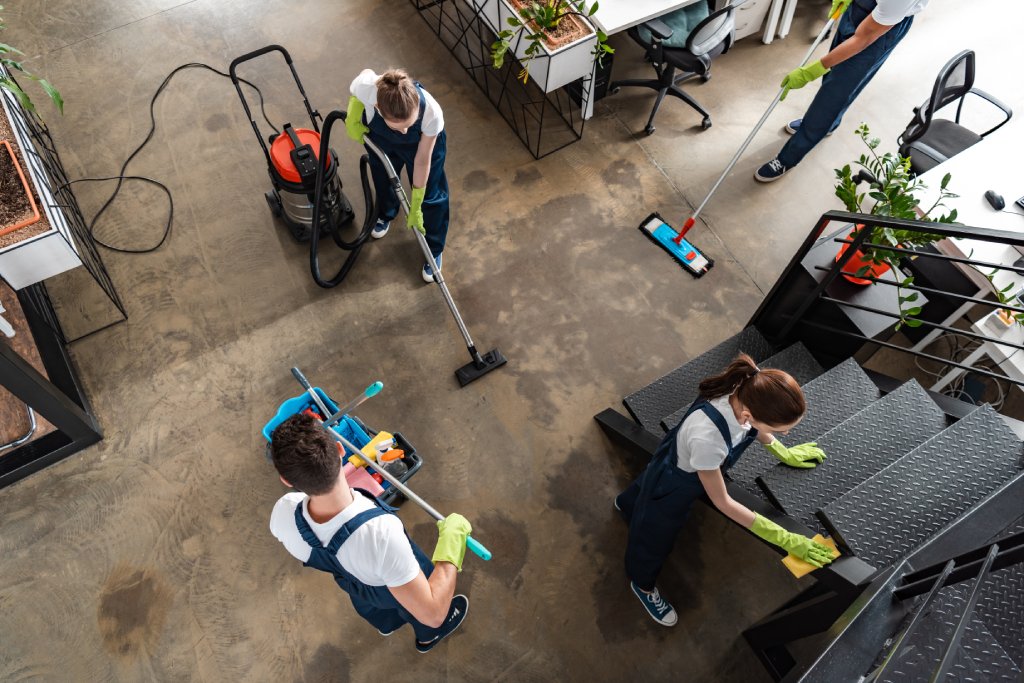
Maintaining compliance is not a one-time project; it is an ongoing operational commitment. When a cleaning company cuts corners on training, fails to document chemical hazards, or operates without proper insurance, they expose your entire facility to severe financial penalties and legal liability.
At SkyLine Cleaning Enterprise Co., we have built our reputation on dependability, rigorous quality control, and strict adherence to Compliance & Standards in Commercial Cleaning. Founded in 2007, we are a proud family-owned and women-owned commercial cleaning company headquartered in Arlington Heights, IL.
We serve commercial facilities within a 40-mile radius of Arlington Heights, covering businesses across Cook County and Lake County, including Chicago, Northbrook, Buffalo Grove, Elk Grove Village, Des Plaines, Mount Prospect, Wheeling, Glenview, Barrington, Highland Park, Libertyville, and Naperville.
Our experienced teams specialize in:
- Professional commercial janitorial services under structured annual contracts.
- VCT floor waxing (strip & wax) and professional floor buffing.
- Deep commercial carpet cleaning.
- Restroom sanitation, day porter services, post-construction cleanup, window cleaning, and high-touch point disinfection.
To ensure your facility starts on the right path, we provide a complimentary deep cleaning on the first day of service for all new annual contract clients. We send an extra crew to thoroughly deep clean your entire space, setting a high benchmark of cleanliness and compliance from day one.
If you are ready to partner with a commercial cleaning provider that prioritizes safety, dependability, and professional supervision, contact us today to discuss a tailored plan for your facility. Visit our SkyLine Commercial Cleaning Services near Chicago page to request a customized quote.