
Clear Out Industrial Facility Construction Debris Ahead of Production Launch
Prepare Your Chicago Industrial Facility for Production
To schedule post-construction cleaning for an industrial facility in Chicago and the greater Arlington Heights area, book a site walkthrough before the construction crew finishes. Identify where debris, fine dust, and residue remain; confirm which areas are safe to enter; and set a final cleaning window before equipment testing or production begins. Keep any suspected hazardous waste separate for assessment and proper disposal.
Industrial sites need more than a quick sweep. Dust can settle on overhead structures, floors, and equipment, while unfinished work can undo a final clean. SkyLine Cleaning Enterprise plans post-construction cleanup around each facility’s access rules and handover schedule, drawing on dependable industrial cleaning practices.
I’m Anna Szczurek, founder of SkyLine Cleaning Enterprise in 2007, and I bring nearly 20 years of commercial cleaning experience to this guide. For Post Construction Cleaning Industrial Facilities Chicago, I’ll walk through the cleanup phases that help facility managers across Chicago and Arlington Heights prepare for production.
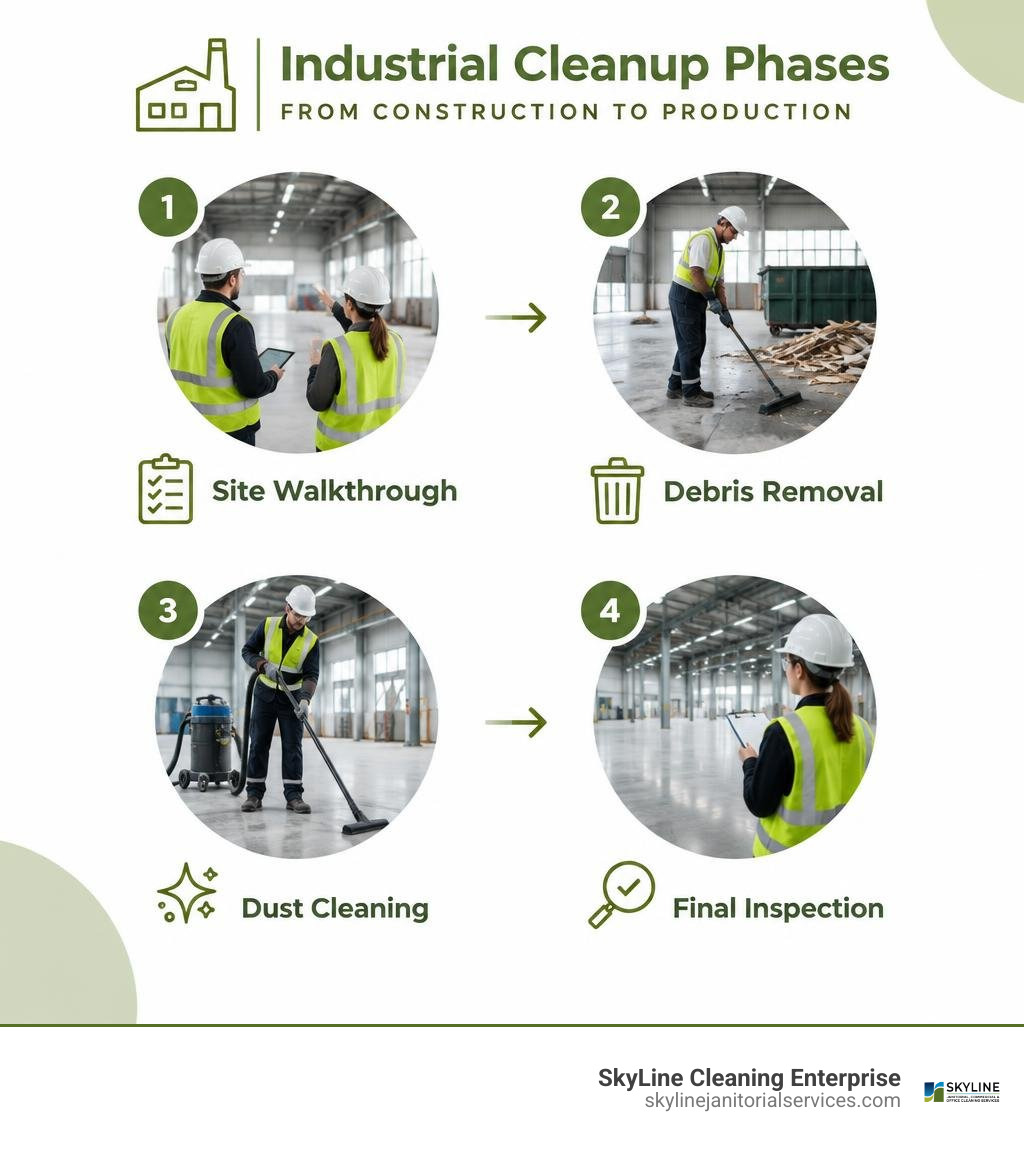
Phase-by-Phase Process for Post Construction Cleaning Industrial Facilities Chicago
Bringing an industrial manufacturing plant, logistics center, or processing facility online requires a structured, multi-phase cleaning approach. Unlike light commercial work, industrial sites harbor abrasive particulates, chemical residues, and high-volume construction refuse that threaten sensitive machinery and worker safety. Professional post-construction cleaning mitigates these workplace hazards before operations commence.
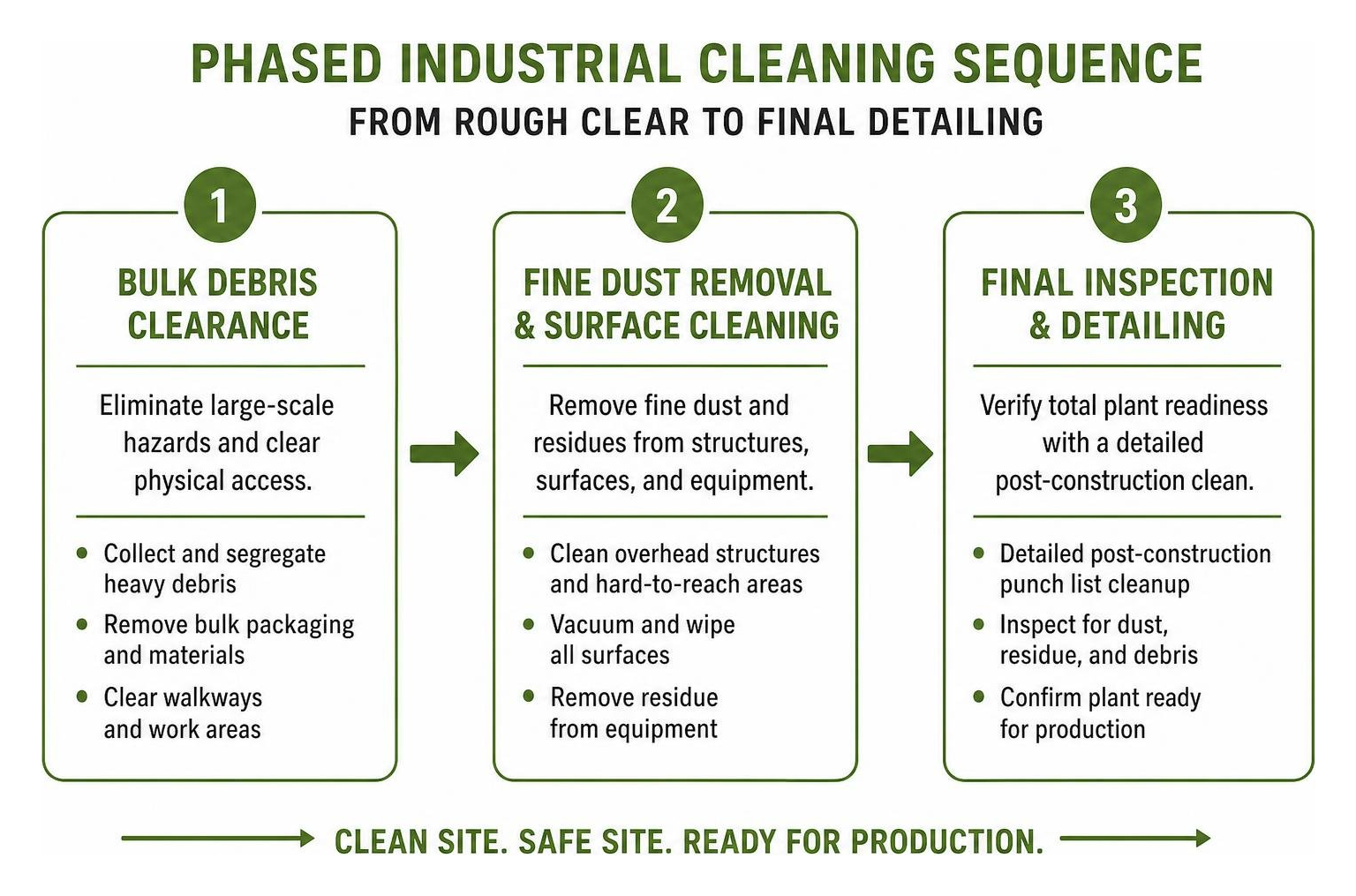
Executing this work demands systematic timing. We divide the industrial cleaning timeline into three targeted phases, ensuring that trades finish their work without re-contaminating detailed areas, concluding with a detailed post-construction punch list cleanup to verify total plant readiness.
Step 1: Bulk Debris Clearance and Coarse Particulate Extraction
The initial rough cleaning phase focuses on eliminating large-scale hazards and clearing physical access across the plant floor. Our teams systematically collect and segregate heavy debris, including discarded framing offcuts, metal shavings, pallet remnants, drywall fragments, and bulk packaging materials.
During coarse extraction:
- Large refuse is manually cleared and loaded into dedicated dumpsters adhering strictly to Cook County disposal and recycling mandates.
- Magnetic sweepers pass across high-traffic aisles and loading bays to capture discarded nails, screws, and metal burrs that cause forklift tire punctures.
- Industrial sweepers remove surface-level masonry sand and coarse drywall grit before fine-particulate extraction begins.
Step 2: High-Bay Structures and Overhead Dust Abatement
Once heavy debris is removed, cleaning proceeds from the top down. Overhead structures act as massive collection shelves for fine construction dust. If unaddressed, routine vibrations from plant machinery will cause these overhead particles to rain down on newly unboxed production lines.
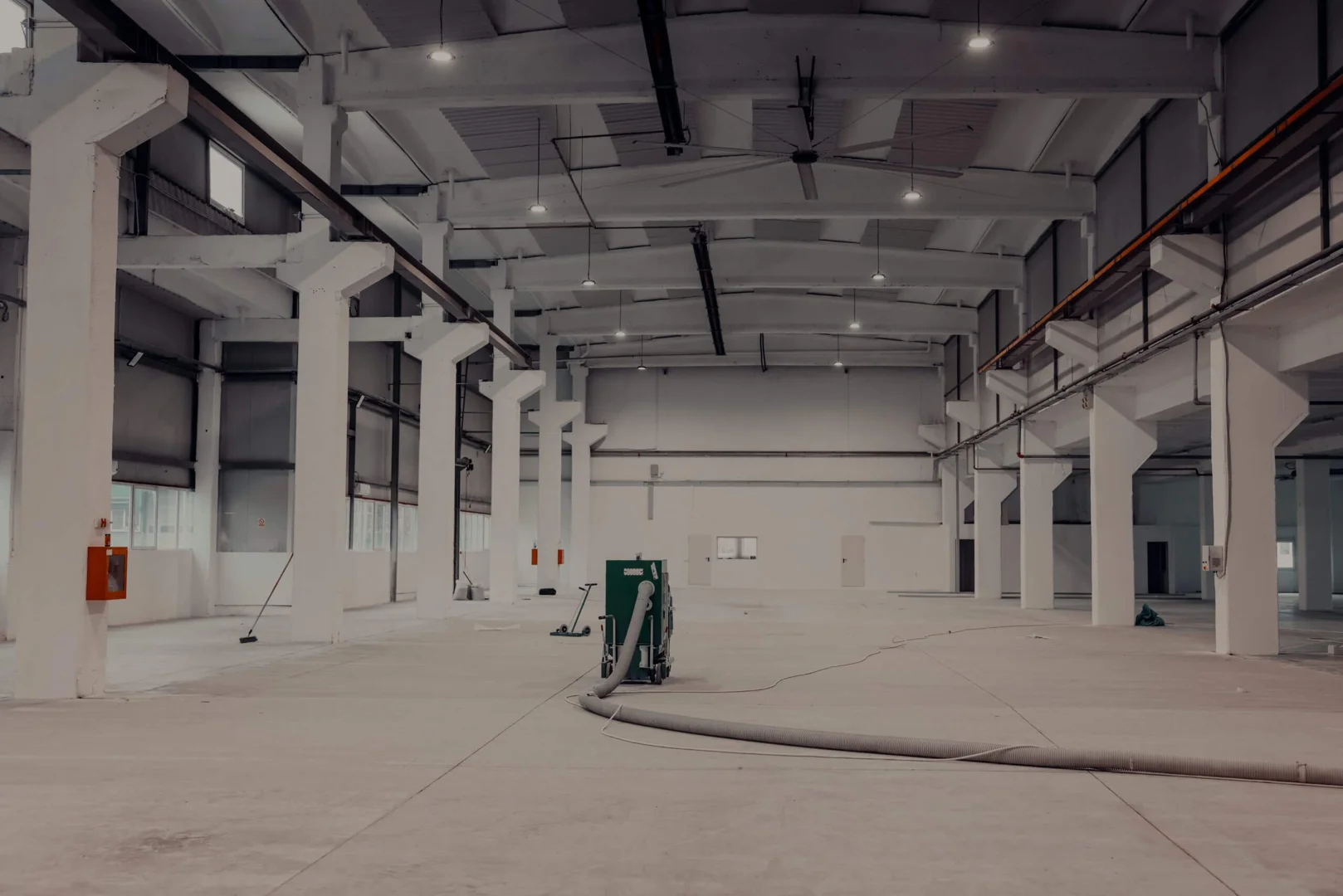
Using scissor lifts, articulating booms, and specialized high-reach gear, technicians execute complete warehouse ceiling cleaning methods across the facility:
- Structural Trusses and Joists: Detailed hand-wiping and vacuuming of all exposed steel beams, purlins, and bridging.
- Overhead Mechanicals: Comprehensive surface cleaning of HVAC supply and return ducting, fire suppression piping, and electrical conduit runs.
- Lighting Systems: Hand-detailing high-bay LED fixtures, reflectors, and hanging sensors to ensure maximum lumen output and prevent thermal buildup from dust blankets.
Step 3: Industrial Floor Scrubbing and Substrate Preparation
Concrete dust generated during cutting, drilling, and masonry installation is heavy, abrasive, and difficult to lift with simple mopping. Our floor remediation process combines mechanical agitation with powerful recovery systems.
Technicians deploy heavy-duty automatic scrubbers equipped with cylindrical brushes and aggressive cleaning solutions to break down compacted construction traffic grime, tire marks, and chalk lines. Slurry extraction systems immediately lift the dissolved particulates into sealed recovery tanks, preventing the re-deposition of fine grit. This leaves clean, porous concrete surfaces ready for sealers, safety line striping, or specialized finishes, ensuring comprehensive industrial warehouse floor cleaning before machinery installation.
Critical Safety Regulations and Contaminant Management
Managing an industrial site handover requires strict adherence to federal and municipal safety regulations. Industrial construction environments generate hazardous airborne particulates that far exceed the dust profiles seen in standard office build-outs.
| Feature / Standard | Industrial Post-Construction Cleaning | Standard Commercial Cleaning |
|---|---|---|
| Primary Dust Hazard | Respirable Crystalline Silica, concrete, metallic dust | Drywall dust, light sawdust, packaging fibers |
| Overhead Clearance | 20 to 40+ ft high-bay ceilings, cranes, trusses | 9 to 12 ft acoustic drop ceilings, light troffers |
| Personal Protective Equipment | N95/Half-mask respirators, eye protection, steel toes | Standard nitrile gloves, basic safety glasses |
| Regulatory Framework | OSHA 29 CFR 1910.134, local environmental codes | Basic municipal waste disposal ordinances |
| Equipment Utilized | High-CFM HEPA scrubbers, ride-on auto-scrubbers | Commercial upright vacuums, flat mops |
Maintaining these benchmarks is essential for passing municipal inspections and securing occupancy permits under Chicago environmental compliance for construction projects.
Silica Dust Mitigation and Air Filtration Protocols
Approximately 70% of construction dust particles are smaller than 10 microns, making them easily inhalable and capable of penetrating deep into the lungs. When handling masonry, brick, block, and concrete substrates, fine crystalline silica presents a severe health hazard.
Our cleanup crews mitigate these risks by adhering strictly to OSHA respiratory protection guidelines. Technicians wear fitted, NIOSH-rated respiratory protection and employ industrial HEPA vacuums that capture 99.97% of airborne particles down to 0.3 microns. By running negative air machines and industrial air scrubbers throughout enclosed zones, we continually cycle and filter ambient air, keeping silica counts well below Permissible Exposure Limits (PEL).
Hazardous Residue Elimination and Industrial Waste Compliance
Construction sites frequently leave behind stubborn chemical residues, including epoxy overspray, solvent splatters, adhesive bonds, curing compounds, and lubricants. Each residue demands specific neutralization and extraction methods to prevent substrate damage or volatile outgassing.
Furthermore, post-construction cleanup must comply with Cook County environmental ordinances governing the disposal of wash water and chemical waste. Slurry generated during floor scrubbing is contained and disposed of through compliant channels rather than being routed into municipal storm drains, safeguarding local waterways and keeping your facility fully compliant.
Specialized Equipment and Methodology for Plant Commissioning
Preparing a sprawling industrial plant for commissioning cannot be achieved with conventional custodial equipment. Industrial scale demands specialized machinery operated by experienced teams.

Why Post Construction Cleaning Industrial Facilities Chicago Requires Heavy-Duty Machinery
Standard vacuum units and push brooms merely disperse microscopic concrete and drywall dust into the air, allowing it to settle hours later. Managing hundreds of thousands of square feet in facilities across Chicago, Arlington Heights, Elk Grove Village, or Des Plaines requires high-output equipment:
- Ride-On Sweepers and Scrubbers: High-capacity units that lay down scrubbing solution, agitate deep within concrete pores, and squeegee the slurry in a single continuous pass.
- High-CFM Industrial HEPA Vacuums: Specialized suction equipment designed to pull heavy masonry dust from expansion joints, machinery pits, and high structural ledges without clogging filters.
- Hydraulic Lift Platforms: Certified scissor and boom lifts that allow personnel to safely reach structural bays exceeding 30 feet.
Investing in high-grade post-construction clearing delivers immediate operational dividends for facilities across Chicago and Arlington Heights by reducing machine maintenance and establishing safer, cleaner workflows from day one.
Preventing Equipment Contamination Ahead of Production Launch
Delicate automated manufacturing equipment, PLCs, conveyor rollers, and cleanroom zones require careful protection during the final cleaning phase. Fine construction grit can rapidly ruin precision bearings, scratch optical sensors, and cause electrical faults inside control enclosures.
Our teams detail these sensitive zones with specialized micro-cleaning techniques:
- Precision dry-wiping and static-dissipative vacuuming around motor assemblies and control panels.
- Careful hand-cleaning of production line framework, guarding, and roller conveyors.
- Restroom and breakroom sanitation paired with expert facility maintenance solutions to prepare administrative annexes alongside production zones.
Selecting an Industrial Post-Construction Partner in the Chicago Area
Selecting the right commercial cleaning contractor directly influences your facility’s launch date. An inexperienced crew lacking industrial training can lead to regulatory fines, project delays, or safety incidents.
Facility managers across Arlington Heights, Chicago, and Cook County use established vetting criteria when assessing commercial cleaning contractors.
Key Criteria for Post Construction Cleaning Industrial Facilities Chicago
When reviewing proposals for your industrial build, ensure your prospective partner meets these non-negotiable operational requirements:
- Verified Insurance Coverage: The contractor must hold active General Liability, Workers’ Compensation, and Auto Insurance policies to protect your facility from liability.
- Direct Supervisory Oversight: Dedicated on-site supervisors must perform regular quality inspections and maintain active communication with your project managers.
- Proven Local Experience: Demonstrated experience managing massive logistical footprints across industrial hubs like Arlington Heights, Chicago, Buffalo Grove, Elk Grove Village, Des Plaines, Mount Prospect, and Northbrook.
- Staffing Depth: A dedicated workforce of 20 to 50+ trained professionals capable of handling aggressive handover schedules.
Budgeting and Timeline Optimization for Zero Production Downtime
Achieving an on-time production launch requires aligning cleaning phases with general contractor milestones. Rather than waiting for total site demobilization, coordinating phased turnovers allows cleaning teams to sanitize completed sections while trades finish remaining punch list items.
Planning post-construction cleaning for Cook County and Lake County facilities helps operations directors align their milestone expectations, preventing costly production line stand-downs.
Frequently Asked Questions About Industrial Post-Construction Cleaning
How far in advance of production commissioning should post-construction cleaning begin?
Post-construction cleaning should typically begin 2 to 3 weeks prior to equipment commissioning. This window allows for a progressive two- or three-phase cleaning schedule: rough bulk debris extraction first, overhead truss and mechanical detailing second, followed by a final floor scrubbing and punch-list detailing immediately before machines are powered on.
What safety certifications and insurance should an industrial cleaning crew carry in Cook County?
Industrial cleaning crews must carry comprehensive General Liability, comprehensive Workers’ Compensation, and commercial Auto Insurance. Technicians must be trained in OSHA standards regarding hazard communication, Personal Protective Equipment (PPE), aerial lift safety, and respirable crystalline silica safety protocols.
How does industrial post-construction cleanup differ from standard commercial cleaning?
Industrial post-construction cleanup involves significantly larger square footage, elevated structural ceilings (often 20 to 40+ feet), heavy abrasive particulates such as concrete and metal dust, and strict regulatory standards. It requires heavy-duty machinery—like ride-on scrubbers and high-CFM HEPA vacuums—along with specialized personal protective equipment rarely required in standard office or retail cleaning.
Conclusion
Transitioning an industrial facility from an active construction zone to an efficient, fully operational production floor requires precision, heavy-duty equipment, and uncompromising safety standards. Eliminating airborne silica, scrubbing embedded concrete dust, and detailing high-bay steel ensures your machinery remains protected and your workforce stays safe from day one.
SkyLine Cleaning Enterprise brings nearly 20 years of commercial expertise to every project. As a family-owned and women-owned commercial cleaning company founded by Anna Szczurek in 2007, we serve manufacturing plants, warehouses, corporate offices, and industrial complexes throughout Cook County and Lake County—operating within a 40-mile radius of Arlington Heights, including Chicago, Elk Grove Village, Des Plaines, Northbrook, and Glenview.
Our 20 to 50+ trained cleaning professionals are fully insured with General Liability, Workers’ Compensation, and Auto Insurance. We provide our own professional equipment and supplies, and every facility receives regular supervisor inspections and individualized service plans under typical annual contracts. As a welcome bonus, new clients receive a complimentary deep cleaning on their first day of service, where we deploy an additional crew to establish the highest standard of cleanliness from the start.
Contact our team today to discuss your plant schedule and request an individualized quote for your upcoming facility launch.