
Detailed Guide to Warehouse Floor Cleaning Machine Options
Types of Warehouse Floor Cleaning Machines and Their Capabilities
Selecting the right commercial floor care equipment requires matching your building layout, floor type, and labor resources with the proper machine category. Industrial environments require heavy-duty scrubbing power to eliminate grease, forklift tire marks, and fine dust to maintain safe operational conditions.
From small stockrooms to multi-acre distribution hubs, modern floor care equipment fits into several distinct machinery classes. Understanding these classifications helps you choose the right balance between equipment cost and daily operational efficiency.
Walk-Behind vs. Ride-On Warehouse Floor Cleaning Machines
Walk-behind scrubbers serve as the workhorse for small to mid-sized industrial footprints and tight layout spaces. Compact walk-behind models feature 14-inch to 17-inch cleaning paths, providing a cleaning efficiency between 10,000 and 14,500 square feet per hour with recovery tank capacities around 4 gallons.
Larger self-propelled walk-behind units feature cleaning paths up to 28 inches, achieving coverage rates up to 30,000 square feet per hour with 14.5-gallon recovery tanks. These self-propelled machines navigate narrow facility aisles smoothly, requiring a minimum path clearance of only 33.5 inches to maneuver around racking corners and narrow staging zones.
For open-area logistics hubs and facilities with scrubbing footprints exceeding 25,000 square feet, ride-on floor scrubbers deliver maximum return on investment. Equipped with 31-inch to 34-inch dual scrubbing heads and solution tanks up to 37 gallons, ride-on models deliver cleaning efficiency ratings between 48,000 and 80,000 square feet per hour.
Upgrading from manual mopping or smaller walk-behind units to a heavy-duty ride-on scrubber can reduce labor costs by up to 50% while significantly boosting worker ergonomics and floor dryness safety.
Sweepers, Combination Units, and Autonomous Warehouse Floor Cleaning Machines
Industrial dry sweepers utilize main cylindrical brooms and side brushes to clear fine dust, sand, wooden pallet chips, and packaging debris without kicking airborne particulate into the air.
However, facilities handling mixed debris usually benefit from combination sweeper-scrubbers. These heavy-duty industrial units feature front-mounted sweeping brooms or side brushes that sweep dry items into a hopper while rear disc or cylindrical brushes apply solution and scrub in a single pass. Single-pass sweeping and scrubbing cuts overall floor cleaning duration in half compared to traditional two-step cleaning methods.
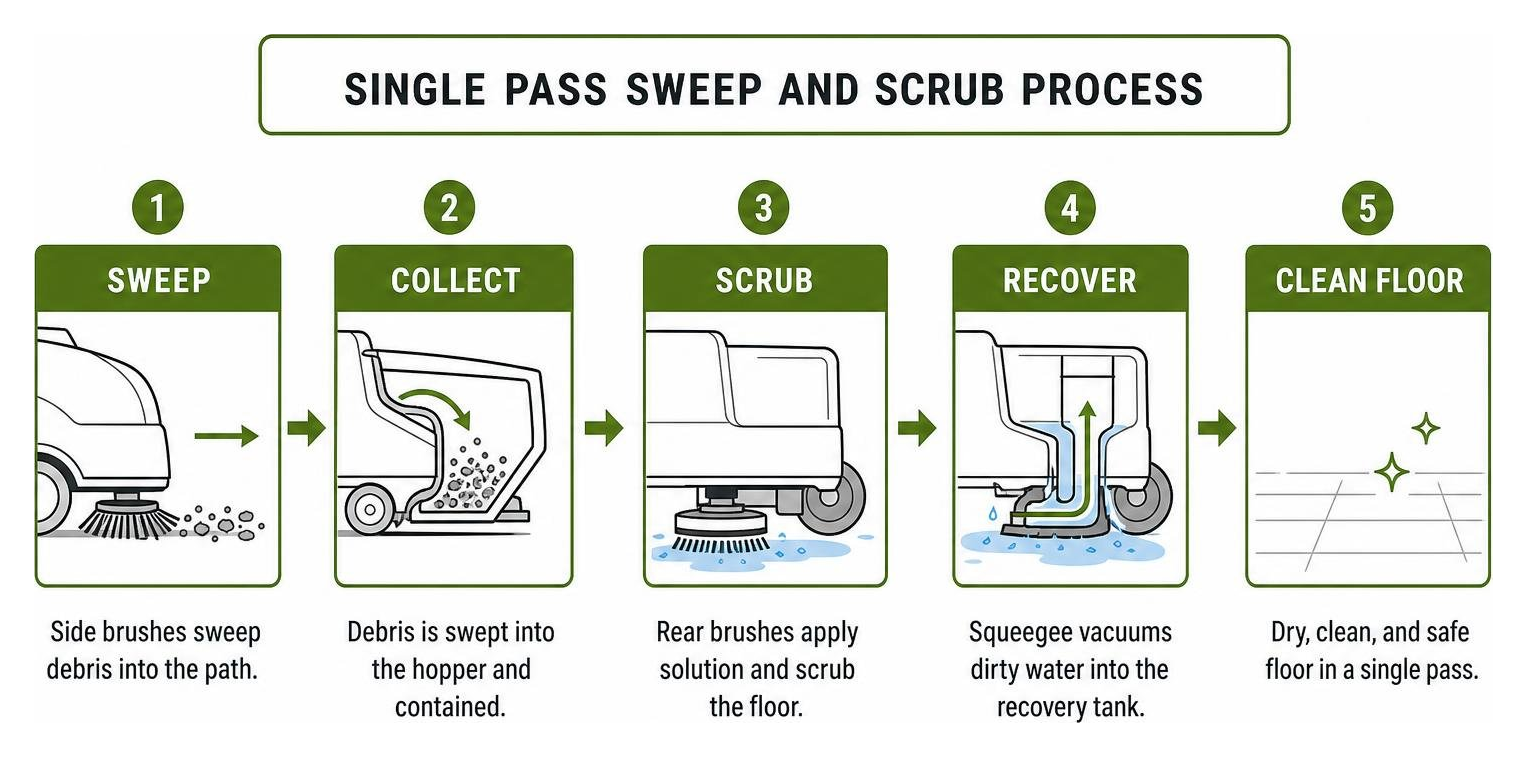
For modern automated distribution hubs facing labor shortages, AI-native autonomous scrubbers offer a round-the-clock solution. Utilizing 3D LiDAR sensors, RGB cameras, and VSLAM navigation, AI-driven robotic scrubbers map facilities, navigate complex traffic paths, and avoid forklifts or staff members safely. Autonomous systems offer continuous cleaning runtimes between 2.5 and 7.5 hours per charge, covering standard cleaning rates up to 21,528 square feet per hour and targeted spot cleaning rates up to 64,583 square feet per hour.
For facilities evaluating high-tech automated floor management options, reviewing detailed specs on autonomous floor scrubbing technology helps clarify how robotic navigation integrates with daily facility operations.
Here is how primary machine classes match typical industrial applications:
- Compact Walk-Behind Scrubbers: Best for narrow aisles, tool rooms, active order-picking zones, and tight mezzanine layouts.
- Self-Propelled Walk-Behind Scrubbers: Ideal for medium-sized manufacturing floors, receiving bays, and light distribution centers.
- Ride-On Floor Scrubbers: Best for expansive regional distribution hubs, main warehouse thoroughfares, and large open floor spaces.
- Combination Sweeper-Scrubbers: Essential for wood processing, heavy manufacturing, and facilities with loose pallet debris and dust.
- Autonomous Robotic Scrubbers: Perfect for multi-shift 24/7 facilities, logistics hubs with consistent aisle maps, and labor-constrained operations needing continuous floor maintenance.
Our comprehensive Industrial Cleaning protocols integrate specialized floor machinery with structured supervisory oversight to ensure your facility maintains high safety and compliance standards.
Key Selection Criteria: Sizing, Capacities, and Facility Factors
Matching a floor cleaning machine to your facility layout requires analyzing tank capacity, battery runtime, down pressure, and spatial constraints.
| Machine Class | Avg. Tank Capacity | Cleaning Path | Max Efficiency (sq ft/hr) | Recommended Footprint |
|---|---|---|---|---|
| Compact Walk-Behind | 4–5 Gallons | 14″–17″ | 10,000–14,500 | Under 15,000 sq ft |
| Standard Walk-Behind | 14.5 Gallons | 22″–28″ | 30,000 | 15,000–40,000 sq ft |
| Mid-Size Ride-On | 18.5–33 Gallons | 28″–31″ | 48,000–75,000 | 40,000–100,000 sq ft |
| Large Heavy-Duty Ride-On | 37+ Gallons | 34″+ | 80,000+ | 100,000+ sq ft |
| Autonomous Robotic Scrubber | 10–20 Gallons | 20″–36″ | 20,000–64,500 (Spot) | Variable / Continuous |
Beyond overall square footage, evaluating aisle widths is crucial. While open thoroughfares accommodate wide 34-inch dual-brush ride-on units, high-density storage racking requires agile machines capable of turning within tight aisle clearances.
Debris profile is another essential factor. Fine dust and minor liquid spills require standard disc pad scrubbers, whereas facilities with wood splinters, gravel, or metal shavings require cylindrical brushes that sweep debris into a tray while scrubbing.
Operator safety and ergonomics are vital when running machinery near active personnel and material transport equipment. Commercial scrubbers operate at quiet sound levels ranging from 62 dBA to 71 dBA, preventing hearing fatigue and enabling daytime operations.
For facilities operating active forklift shifts, choosing machinery equipped with safety packages—including turn signals, audio-visual reverse alarms, and forward-projecting blue safety lights—helps maintain OSHA safety compliance and prevents collision risks.
Through our specialized New vs. Refurbished Equipment: Cost, Warranties, and Dealer Support
When sourcing commercial floor scrubbers, operations leaders generally choose between direct factory purchasing, authorized equipment dealerships, or purchasing pre-owned/refurbished units. Factory-direct purchases eliminate standard 40% to 50% dealer markups, offering lower initial acquisition costs and standard two-year manufacturer warranties. Alternatively, purchasing through established local equipment dealers provides localized hands-on support, specialized operator training, and readily available loaner machines during major repairs. For facilities looking to maximize capital budget efficiency, exploring pre-owned or certified reconditioned industrial equipment provides access to heavy-duty machinery at accessible price tiers. Refurbished models generally range from $6,950 for walk-behind scrubbers up to $57,500 for heavy-duty gas power sweepers. To maintain machine longevity and scrubbing performance, certified pre-owned scrubbers should always be rebuilt with authentic original equipment manufacturer (OEM) replacement components. Reviewing available options for commercial industrial floor cleaning equipment gives facility leaders insight into how heavy-duty steel frame construction compares across market options. Common mistakes to avoid when purchasing industrial floor care equipment include: Long-term machinery reliability depends heavily on battery selection and disciplined daily preventative maintenance routines.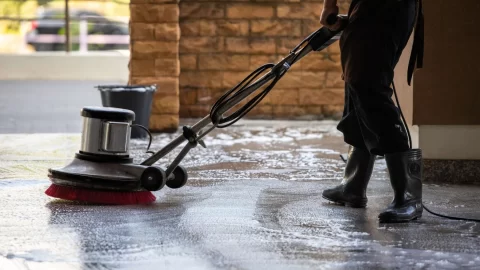
Preventative Maintenance, Battery Tech, and Floor Surface Care
| Battery Type | Runtime per Charge | Maintenance Need | Opportunity Charging | Shift Compatibility |
|---|---|---|---|---|
| Flooded Lead-Acid | Up to 4 Hours | Weekly fluid top-offs | Not recommended | Single-shift operations |
| Lithium-Ion (LFP) | 3.5 to 7.5 Hours | Zero maintenance | Supported (Lunch breaks) | Multi-shift / 24-7 operations |
Lithium-ion (LFP) batteries eliminate regular cell watering care and allow opportunity charging during shift breaks, enabling up to 13 hours of operational cleaning per 24-hour cycle. Flooded lead-acid batteries require dedicated charging areas, long recharge windows, and regular fluid checks to prevent battery degradation.
To protect vacuum suction systems, operators should inspect yellow-coded daily touchpoints after every cleaning run. Cleaning the recovery tank suction filter, rinsing squeegee blades, and draining dirty wastewater prevents foul tank odors and clogs.
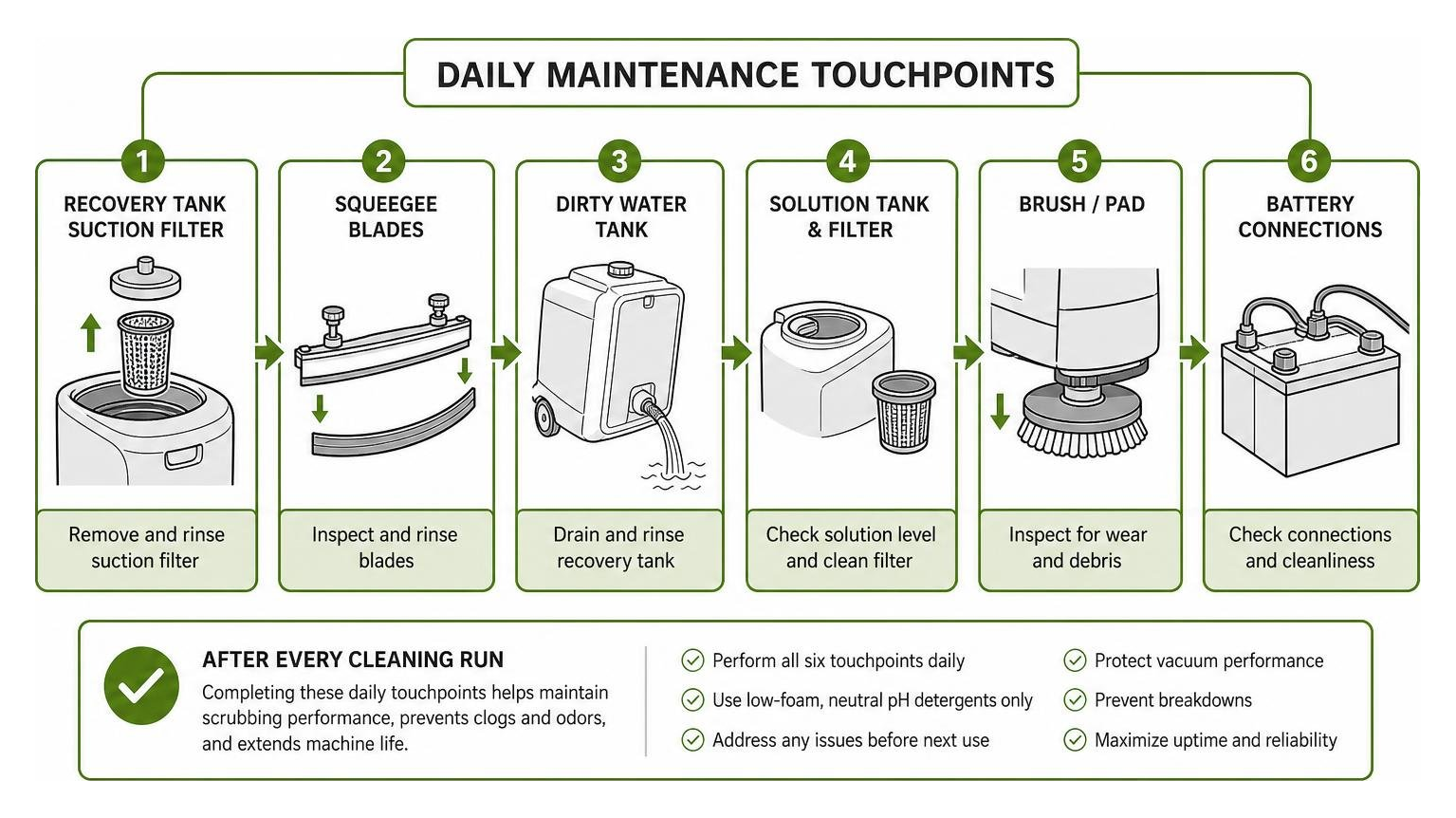
Protecting internal scrubber plumbing requires using low-foam, neutral pH commercial detergents. Bleach, harsh solvents, and high-foaming soaps break down internal seals and ruin vacuum bypass motors.
Different commercial floor materials require tailored brush and pad setups:
- High-Gloss Epoxy Coatings: Safe with non-abrasive soft red pads or soft nylon brushes that lift surface grime without dulling polished resin finishes.
- Sealed Concrete Floors: Resilient surfaces that handle medium-pressure polypropylene brushes or soft pads for daily grease removal.
- Vinyl Composition Tile (VCT): Safe with soft polishing pads and neutral pH cleaners. Facilities looking for detailed guidance on tile care can review our Detailed Guide to VCT Floor Care Services in Glenview. When protective floor finish breaks down, scheduled Floor Waxing strips away embedded dirt and restores a durable high-gloss protective barrier.
Frequently Asked Questions About Industrial Floor Equipment
Keeping warehouse floors safe and clean requires practical answers to common machinery and floor maintenance questions.
Here are answers to frequent questions facility managers ask when evaluating their floor care needs:
What is the difference between disc brushes and cylindrical brushes on warehouse scrubbers?
Disc brushes feature flat, round pad drivers that rotate parallel to the floor, making them ideal for high-gloss epoxy, VCT, and smooth sealed concrete where uniform down-pressure restores gloss and lifts light dust.
Cylindrical brushes rotate counter-directionally at higher speeds, utilizing stiff bristles to scrub textured concrete floors and grout lines while sweeping light solid debris (such as packaging chips and wood splinters) into an integrated hopper tray in a single pass.
How do lithium-ion batteries compare to traditional lead-acid batteries in floor scrubbers?
Traditional flooded lead-acid batteries deliver up to 4 hours of runtime, require weekly water topping, and require an 8-hour recharge cycle plus cooling periods.
Lithium-ion batteries require zero fluid maintenance, offer continuous runtimes between 3.5 and 7.5 hours, and support fast opportunity charging during lunch breaks. This enables multi-shift cleaning without battery swapping.
Can floor scrubbers be used on high-gloss epoxy or sealed VCT warehouse floors?
Yes, floor scrubbers clean epoxy and sealed VCT surfaces safely when equipped with soft red or white non-abrasive pads, low-foam neutral pH detergent, and properly adjusted squeegee blades.
Avoid aggressive black stripping pads or harsh chemical solutions during daily maintenance, as these can dull floor finishes. When finishes show heavy wear, executing a formal program to Strip Wax Floors removes oxidized wax coats before reapplying protective industrial sealers.
For facilities that want consistent maintenance without investing capital in machinery, outsourcing to our professional Commercial Floor Cleaning teams ensures top-tier clean standards using professional equipment.
Conclusion and Professional Facility Support
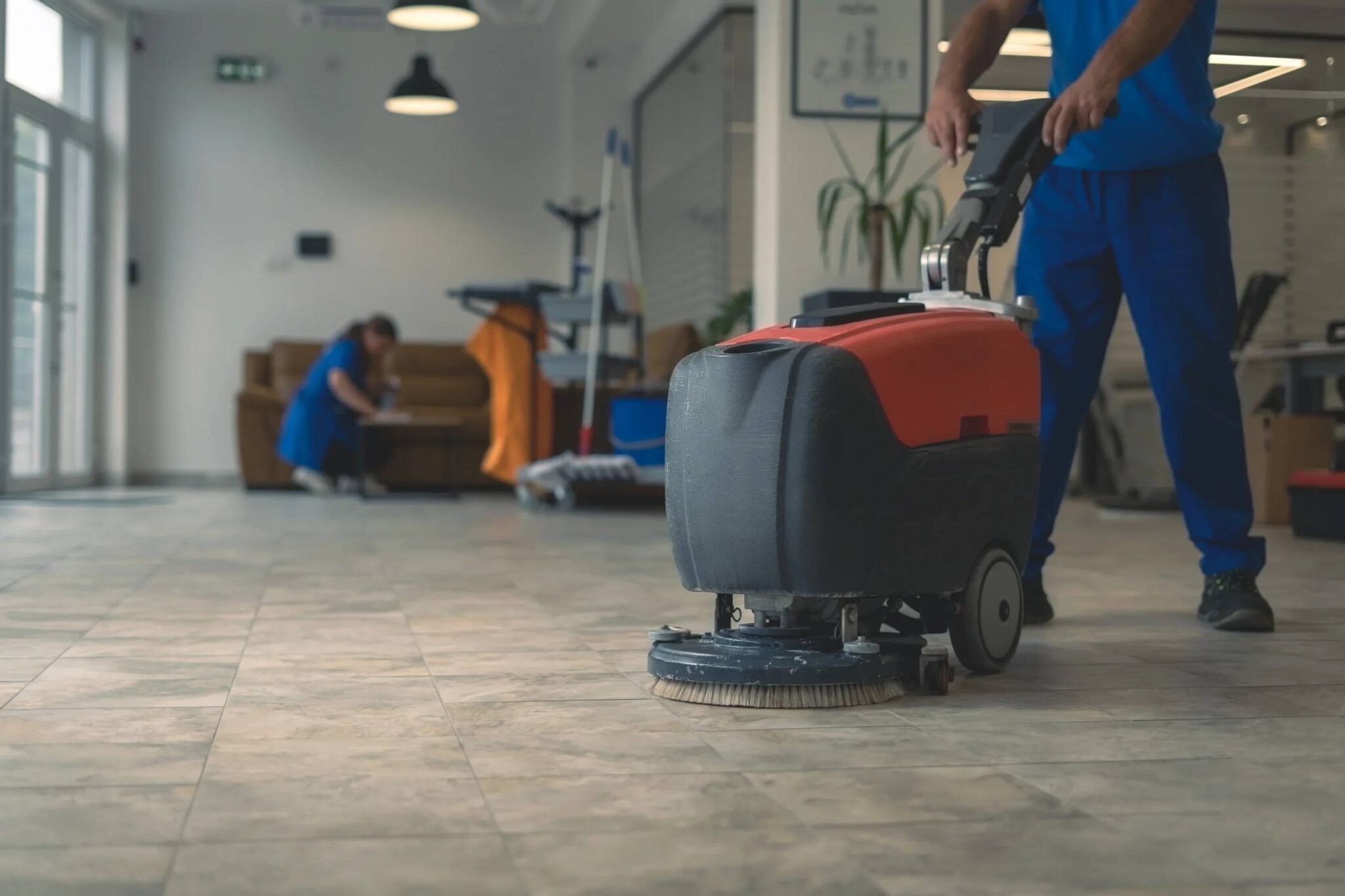
Selecting the right warehouse floor cleaning machines involves matching facility square footage, layout narrowness, and floor materials with proper equipment specifications. Whether you deploy compact walk-behind scrubbers, heavy-duty ride-on units, or AI-driven autonomous equipment, maintaining clean floors improves workplace safety, reduces labor costs, and keeps your operations fully compliant with industry standards.
Purchasing and servicing commercial scrubbing equipment requires substantial capital investment, routine maintenance, operator training, and ongoing management. Many operations managers across Chicago, IL, and Arlington Heights, IL, choose to partner with experienced commercial cleaning specialists to keep their facilities spotless without hardware headaches.
SkyLine Cleaning Enterprise Co. is a women-owned and family-owned commercial cleaning company founded in 2007, headquartered in Arlington Heights, IL. For nearly two decades, we have provided trustworthy, high-quality janitorial care to commercial facilities, warehouses, corporate offices, medical buildings, and educational institutions in Chicago, Arlington Heights, and within a 40-mile radius of Arlington Heights.
We provide our own professional equipment, commercial supplies, and supervisory oversight, ensuring full compliance and reliable performance on every shift.
As a welcome bonus, new annual service clients receive a complimentary first-day deep clean. We send a dedicated crew to thoroughly deep clean your entire facility, establishing the highest standard of cleanliness from day one.
To learn more about tailored maintenance programs for your logistics or distribution facility, explore our dedicated Warehouse Cleaning services or contact SkyLine Cleaning Enterprise Co. today to request your customized facility consultation.