
The Critical Role of Kitchen Exhaust Cleaning in Chicago & Arlington Heights
Commercial hood cleaning is the professional process of removing grease, debris, and contaminants from your restaurant’s entire exhaust system—including the hood, filters, ductwork, and rooftop fans. Here’s what you need to know:
Why Commercial Hood Cleaning Matters:
- Fire Prevention – Grease buildup is the leading cause of restaurant fires
- Health Code Compliance – Required by NFPA 96 standards and local Chicago/Arlington Heights ordinances
- Operational Efficiency – Clean systems reduce energy costs and extend equipment life
- Insurance Protection – Proof of regular cleaning is often required for valid insurance coverage
Recommended Cleaning Frequency:
- Monthly – Solid fuel cooking (wood-fired ovens, charbroilers)
- Quarterly – High-volume restaurants and commercial kitchens
- Semi-Annually – Moderate-volume operations
- Annually – Low-volume kitchens (churches, seasonal facilities)
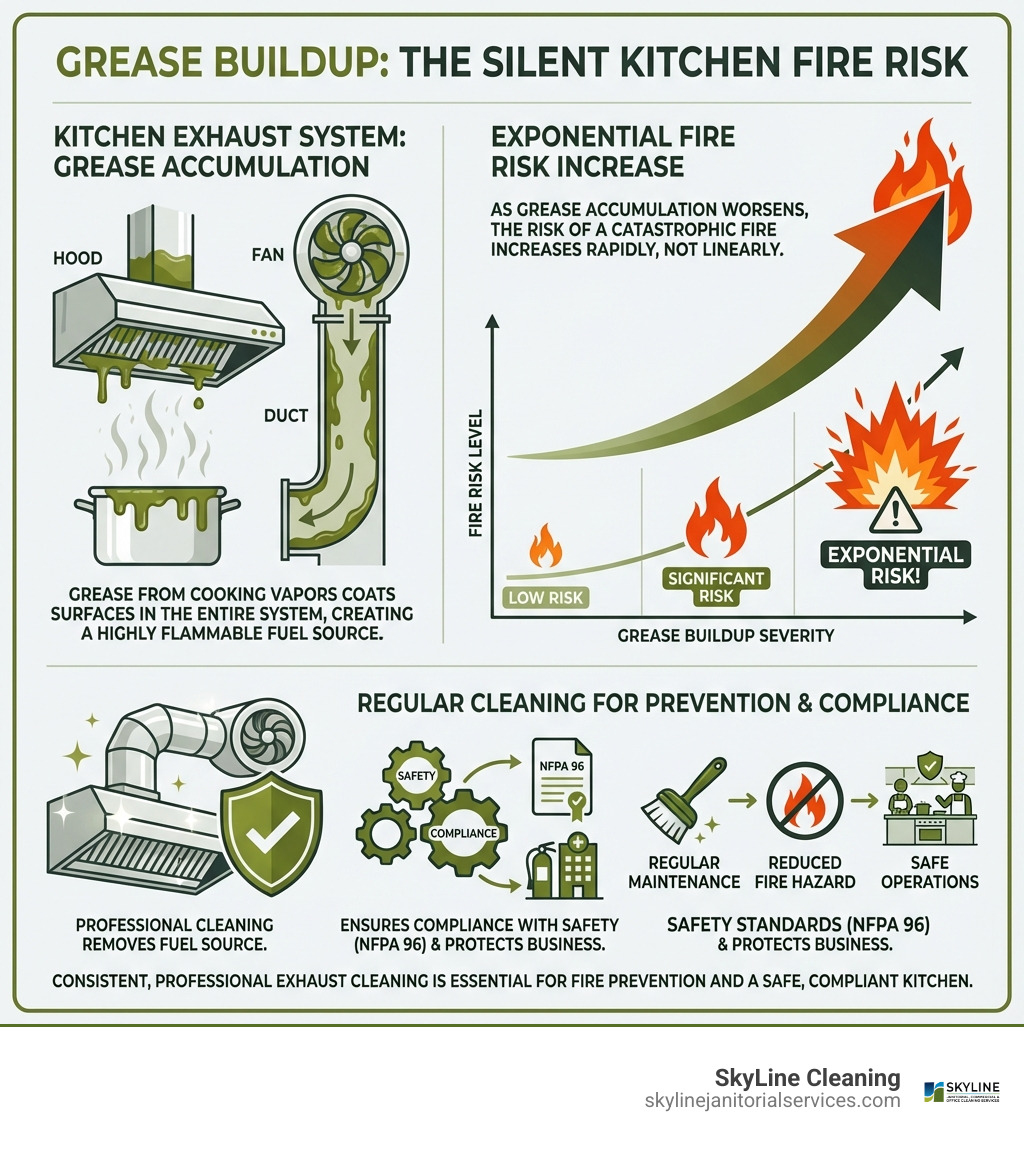
Grease buildup in exhaust systems is a leading cause of restaurant fires, and the risk grows as accumulation increases. In Chicago and Arlington Heights, strict health and fire codes mean that neglecting your system can lead to fines, failed inspections, or closure. A clogged system also drives up energy costs and shortens equipment life. Regular professional cleaning is a critical investment in your business’s safety, compliance, and efficiency.
I’m Anna Szczurek, founder of SkyLine Commercial Cleaning, and since 2007, my team and I have provided professional commercial hood cleaning and janitorial services to businesses throughout Cook County, including Arlington Heights and Chicago. Our certified technicians follow NFPA 96 standards to ensure your kitchen exhaust system is safe, compliant, and operating efficiently—so you can focus on running your business with confidence.
Key commercial hood cleaning vocabulary:
- restaurant maintenance services
- professional cleaning and maintenance services
- janitorial and maintenance services
What is Commercial Hood Cleaning?
Commercial hood cleaning is a deep-cleaning process for the entire kitchen exhaust system. This isn’t just wiping the visible hood; it addresses every component designed to capture and expel airborne contaminants from your cooking area.
The “kitchen exhaust system” includes several critical parts:
- The Hood: The canopy above cooking appliances that captures smoke, heat, and grease.
- Filters: Metal baffles that catch grease before it enters the ducts.
- Ducts: Channels that transport air and grease out of the building.
- Exhaust Fan: The rooftop fan that pulls air through the system.
The primary purpose is grease and contaminant removal to achieve fire prevention. By cleaning out flammable deposits, we drastically reduce the risk of a devastating kitchen fire, protecting your property, staff, and customers.
Key Benefits for Your Arlington Heights and Chicago Business
Investing in regular, professional commercial hood cleaning offers benefits that directly impact your safety, efficiency, and bottom line in Arlington Heights and Chicago.
- Reduced Fire Risk: Grease buildup is a leading cause of restaurant fires. A clean exhaust system significantly reduces this risk, safeguarding your property and preventing potential business closure.
- Improved Air Quality: A clean system efficiently removes smoke, steam, and odors, creating a more comfortable environment for staff and preventing smells from reaching your dining area.
- Health Code Compliance: A clean exhaust system is a non-negotiable requirement for passing health inspections in Illinois. Non-compliance can result in fines or closure. Our services include comprehensive Disinfection & Sanitization to meet the highest standards.
- Lower Energy Bills: When grease accumulates, the exhaust fan works harder and consumes more energy. A clean system operates efficiently, reducing energy consumption.
- Extended Equipment Life: The strain of a clogged system wears down your exhaust fan and other components. Regular cleaning reduces this wear and tear, extending the lifespan of your equipment.
- Improved Kitchen Hygiene: A clean system prevents grease from dripping onto food prep surfaces, fostering a more hygienic and sanitary environment.
The High Stakes of Neglect: Fire, Health, and Financial Risks
Ignoring regular commercial hood cleaning is a gamble with severe consequences for your Chicago or Arlington Heights business.
The most immediate risk is fire. Superheated, built-up grease is highly flammable and creates a severe fire hazard that can spread quickly through ductwork, endangering lives and property.
Beyond fire, a dirty system compromises air quality, leading to unsanitary conditions and potential health department fines or even business closure. Financially, the repercussions are crippling. An insurer may deny your claim for a fire caused by a neglected system, as many policies require proof of professional hood cleaning. Neglect also leads to higher energy costs and premature equipment failure.
Finally, a kitchen with poor air quality and high fire risk is a dangerous workplace, impacting employee safety and morale.
Telltale Signs Your Exhaust System Needs Cleaning
While a regular schedule is key, certain signs indicate your system needs immediate commercial hood cleaning.
One of the most obvious indicators is visible grease buildup. If you see a thick, sticky layer of grease on the hood or filters, the system is saturated and needs cleaning. The hidden ductwork is often far worse.
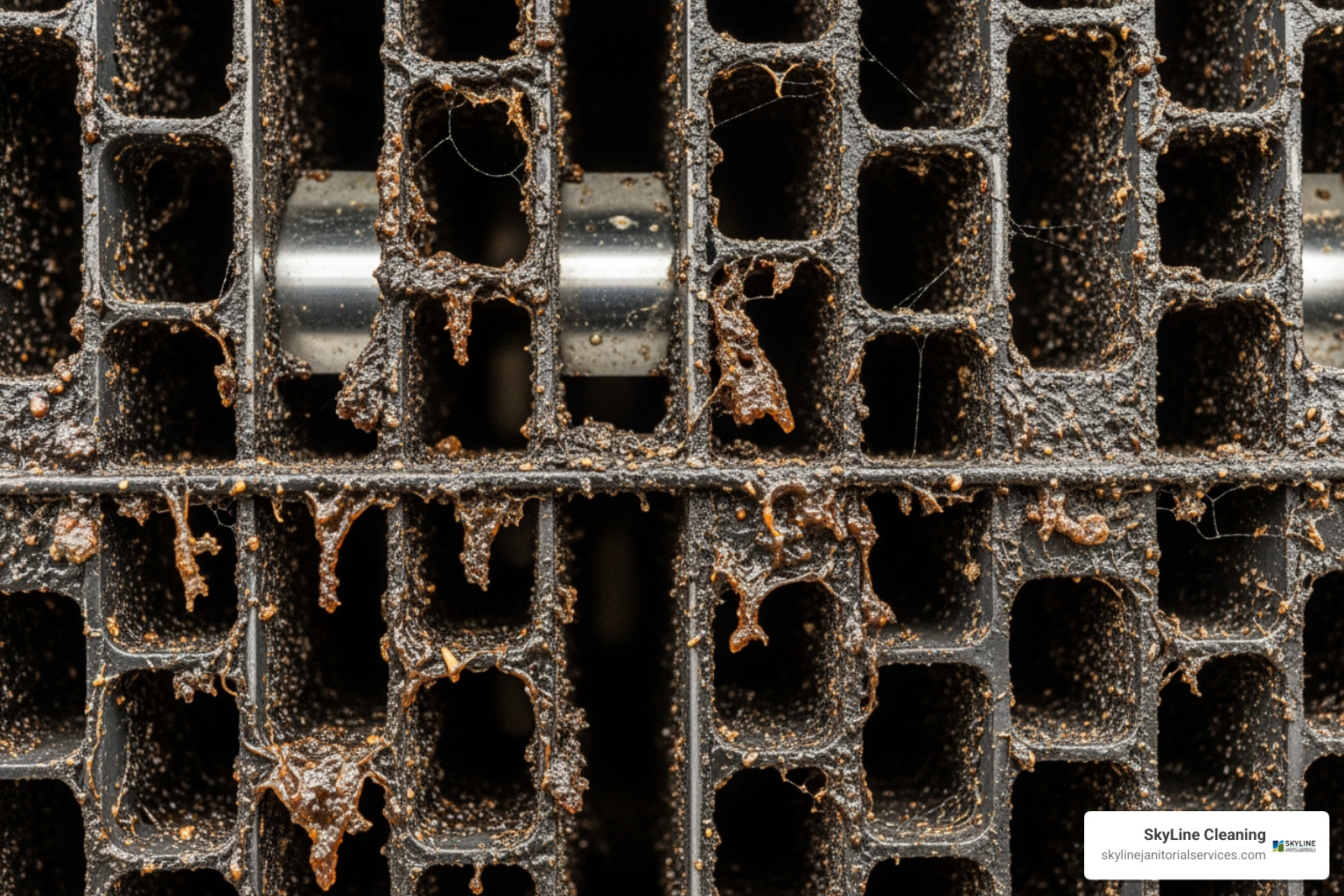
Other common signs include strong odors lingering in the kitchen or dining area, or if smoke is not clearing efficiently, indicating poor ventilation. Pay attention to your exhaust fan; a noisy fan may be struggling under the weight of grease. In extreme cases, dripping grease from the hood is a highly dangerous sign of severe buildup.
A failed inspection by a fire marshal or health inspector is a definitive sign your system is not up to code. If you’ve received a warning, it’s time to call the professionals.
Understanding the Professional Commercial Hood Cleaning Process
Professional commercial hood cleaning is a precise, multi-step systematic cleaning process designed to decontaminate your entire kitchen exhaust system. Our certified technicians in Chicago and Arlington Heights follow NFPA 96 guidelines, using specialized degreasing agents, high-powered hot water pressure washing, and strict safety protocols. The process takes 3 to 6 hours on average, depending on system size and condition, ensuring it operates at peak performance and is fully compliant.
Pre-Cleaning Preparations
Thorough preparation is essential to protect your kitchen and ensure safety.
- Initial Inspection: Our technicians start with a comprehensive inspection to assess grease buildup, note any damage, and plan the cleaning strategy.
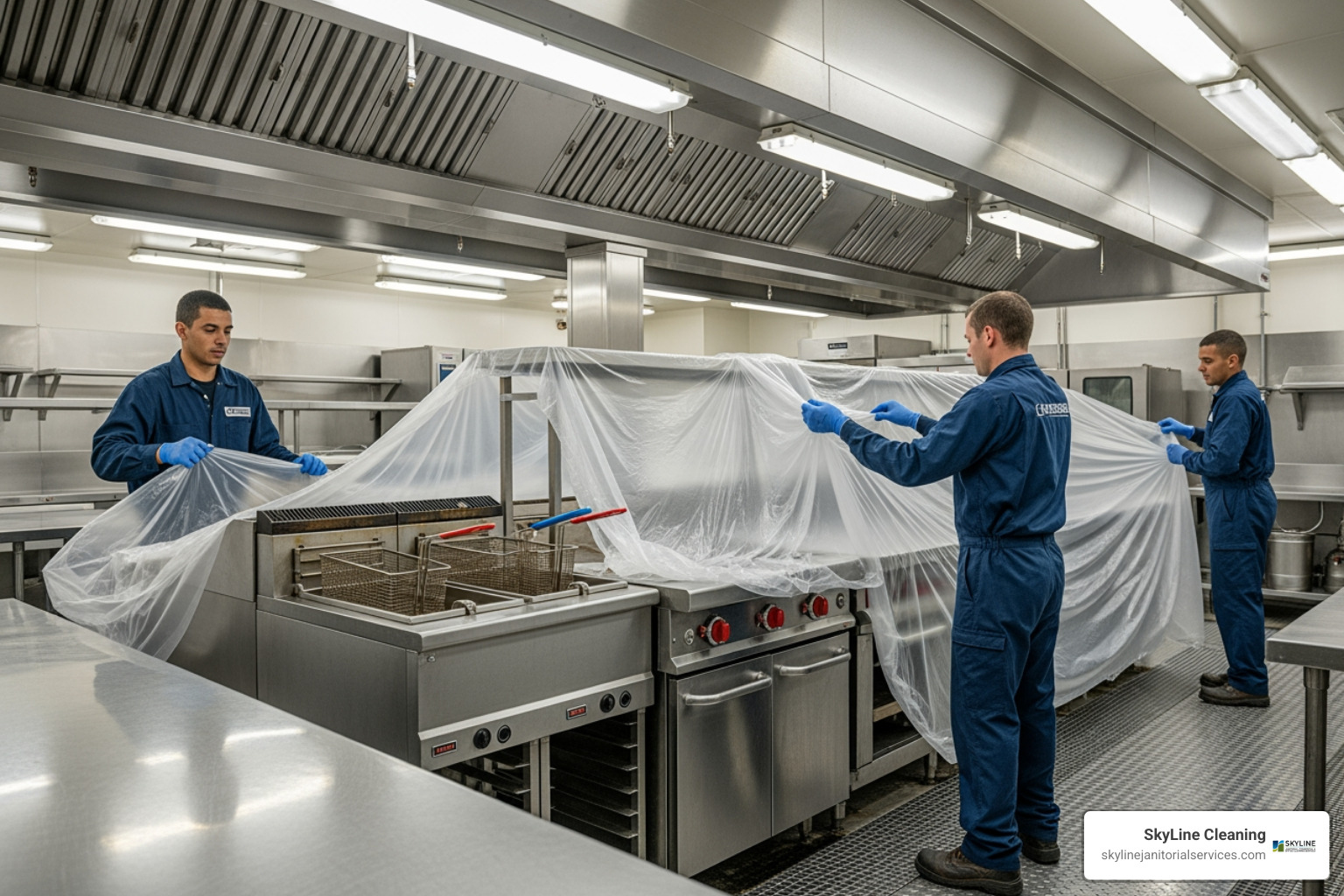
- Protecting Kitchen Equipment: All cooking appliances and counters are carefully covered with heavy-duty plastic sheeting to protect them from cleaning agents and runoff.
- Shutting Off Pilot Lights: For safety, all pilot lights and gas valves on cooking appliances are shut off before cleaning begins.
- Kitchen Prep: We clear the area of hazards and wrap the hood in plastic to funnel greasy water into containment barrels. Our approach can also include Power Washing Services for exterior areas.
The Deep Clean: From Hood to Rooftop Fan
Once prepped, our team begins the deep clean of your entire exhaust system.
- Filter Soaking: Removable grease filters are submerged in a specialized degreasing solution to break down stubborn grime.
- Duct Scraping: For heavily soiled ducts, our technicians manually scrape away hardened grease before applying chemical degreasers.
- Exhaust Fan Degreasing: The rooftop exhaust fan is removed from its housing and sprayed with degreasing chemicals. This step includes an exhaust fan belt inspection for wear and tear.
- Pressure Washing: After the degreaser has set, the entire system—ducts, hood interior, and fan—is cleaned with high-pressure hot water (up to 2,000 psi) to flush away all dissolved grease.
- Polishing Stainless Steel: Once clean and dry, we polish stainless steel surfaces on the hood, restoring its shine and making future cleaning easier.
Post-Cleaning: Documentation and Certification
Our job isn’t finished until your system is restored and documented.
- System Reassembly: All components, including filters and the exhaust fan, are carefully reinstalled.
- Final Inspection: We conduct a final inspection to verify that all grease has been removed and the system meets NFPA 96 standards. We also test the fan to ensure it operates correctly.
- Certification Sticker: A certification sticker is affixed to your hood, as required by NFPA 96. It indicates the service date and the next scheduled cleaning date, which is crucial for inspectors.
- Service Report and Before-and-After Photos: We provide a detailed service report and before-and-after photos, offering tangible proof of our thorough work and ensuring full transparency for any inspections.
Compliance and Safety Standards for Illinois Businesses
For commercial kitchens in Chicago and Arlington Heights, adhering to compliance and safety standards is a legal and ethical imperative. These regulations are designed to prevent fires and protect public health. Our commercial hood cleaning services are performed to meet and exceed these standards.
We operate under the watch of the fire marshal and health inspector, who conduct regular inspections. Failure to comply can lead to severe penalties. Meeting these standards is also often a prerequisite for valid insurance requirements. Our services are fully compliant with state and local Chicago and Arlington Heights ordinances.
Decoding NFPA 96: The Gold Standard for Kitchen Safety
The National Fire Protection Association (NFPA) 96 provides the gold standard for kitchen safety. Compliance with this standard is a legal requirement in Illinois. NFPA 96 outlines comprehensive rules for the design, operation, and cleaning of kitchen exhaust systems. Our certified technicians are experts in NFPA 96, ensuring our commercial hood cleaning services bring your system into full code compliance, which is vital for passing inspections and preventing fires.
NFPA 96 Cleaning Frequency Guidelines
NFPA 96 provides clear guidelines for commercial hood cleaning frequency based on the type and volume of cooking.
Here are the recommended cleaning schedules:
- Monthly for systems serving solid fuel cooking operations (e.g., wood-fired ovens, charbroilers).
- Quarterly (every three months) for systems serving high-volume cooking operations, such as 24-hour restaurants or those with charbroiling and frying.
- Semi-annually (every six months) for systems serving moderate-volume cooking operations.
- Annually (once a year) for systems serving low-volume kitchens, such as churches, day camps, or seasonal businesses.
These are minimum requirements. More frequent service may be necessary depending on usage to ensure safety and compliance.
The Role of Insurance and Local Compliance
Professional commercial hood cleaning is crucial for your business’s financial and legal security, especially regarding insurance policy validity and local compliance.
Insurance companies often mandate regular, documented hood cleaning as a condition of coverage. Without proof of compliance, your policy could be invalidated in the event of a grease fire, leaving you responsible for all costs. Regular cleaning provides crucial liability reduction.
Furthermore, businesses in Chicago and Arlington Heights are subject to rigorous inspections. Adhering to Chicago and Arlington Heights fire codes and health ordinances is non-negotiable and helps you avoid costly fines and operational disruptions. For more insights, our Commercial Cleaning Companies Guide offers valuable information.
Choosing the Right Hood Cleaning Partner in Arlington Heights & Chicago
Selecting the right professional for your commercial hood cleaning in Arlington Heights and Chicago is a critical decision for your business’s safety and compliance. You need a partner, not just a cleaner.
Look for companies with certified technicians, a fully insured company status, and demonstrable local experience in the Chicago area. Always check customer reviews and testimonials to gauge their reputation. For local providers, you might search for terms like Commercial Cleaning Near Me.
Qualifications to Look For: Certification, Insurance, and Experience
When vetting a cleaning service, prioritize these qualifications:
- NFPA Certified Technicians: Ensure technicians are certified in NFPA 96 standards. This guarantees they have the specialized knowledge to clean your system correctly and safely according to industry requirements.
- Comprehensive Insurance Coverage: Verify the company carries adequate liability insurance and workers’ compensation. This protects your business from any damages or injuries that might occur during the cleaning process.
- Proven Experience and Documentation: Look for a company with a solid track record. They should provide before-and-after photos and be able to offer local references from other businesses in Chicago or Arlington Heights to confirm their reliability.
Professional vs. DIY Commercial Hood cleaning
While DIY cleaning might seem like a way to save money, professional service offers benefits that are impossible to replicate in-house. The stakes are too high for shortcuts.
Here’s a comparison:
| Feature | Professional Commercial Hood Cleaning | DIY Cleaning Attempts |
|---|---|---|
| Thoroughness | Cleans the entire system (hood, filters, ducts, rooftop fan), including inaccessible areas. | Typically cleans only visible parts of the hood and filters. Ducts and fan neglected. |
| Safety | Performed by trained, certified technicians with proper safety gear and equipment, minimizing risk of injury. | High risk of injury from falls, chemical burns, or electrical hazards. |
| Compliance | Guaranteed to be certified to NFPA 96 standards, providing required documentation. | Non-compliant, lacking proper documentation, leading to fines and insurance issues. |
| Cost | Upfront investment for a comprehensive, compliant service. Reduces long-term costs from fires/fines. | Appears cheaper, but has high hidden costs from fires, fines, and equipment damage. |
| Equipment | Uses specialized industrial-grade degreasers, hot water pressure washers, and access tools. | Relies on basic tools and consumer-grade cleaners, ineffective for heavy grease. |
DIY attempts are often incomplete, leaving dangerous grease buildup in hidden areas and leaving your business vulnerable to non-compliance penalties.
Questions to Ask a Potential Service Provider
Choosing the right commercial hood cleaning partner requires asking the right questions to assess their expertise and reliability.
- Are you NFPA 96 certified? This confirms their technicians are trained in the industry’s highest safety standards.
- Are you fully insured (liability and workers’ compensation)? Request proof of insurance to protect your business from unforeseen incidents.
- Do you provide photo documentation (before and after) and a detailed service report? This ensures transparency and provides proof of work for inspectors.
- What is your full cleaning process, from preparation to post-cleaning? A reputable company can clearly articulate their systematic approach.
- Can you provide local references from other businesses in Chicago or Arlington Heights? Speaking with existing clients offers valuable insight into their quality of service.
Frequently Asked Questions about Commercial Hood Cleaning
Here are some common inquiries we receive from businesses in Arlington Heights and Chicago about commercial hood cleaning services:
How long does a typical hood cleaning service take?
The average time for a typical hood cleaning service is 3 to 6 hours. The exact duration depends on the system’s size, condition, and complexity. Heavily soiled or large systems may take longer, as our priority is a thorough, comprehensive clean, not a rushed job.
Will the cleaning process disrupt my business operations?
No. We understand that minimizing disruption is paramount, which is why we offer after-hours service and overnight cleaning. Our team works around your schedule to ensure your kitchen remains operational during business hours.
We schedule cleanings during your non-operational times, such as late evenings or overnight. This flexible scheduling means there’s no downtime for your kitchen, allowing you to continue serving customers without interruption.
What kind of documentation should I receive after the service?
After every professional commercial hood cleaning, you will receive comprehensive documentation that serves as proof of compliance.
- Detailed Service Report: This document outlines the work performed, components cleaned, and any observations or recommendations.
- Before-and-After Photos: We provide visual evidence of the cleaning, showing the condition of your system before and after our service.
- Certification Sticker: As required by NFPA 96, a sticker is affixed to your hood indicating the cleaning date and the next recommended service date. This is vital for inspectors.
- Proof of Compliance: Collectively, these inspector-ready documents serve as your official proof of compliance for fire marshals, health inspectors, and insurance providers.
Conclusion: Protecting Your Investment and Ensuring Safety
In the competitive culinary scenes of Chicago and Arlington Heights, professional commercial hood cleaning is essential. It is the cornerstone of fire prevention, offers significant health and safety benefits, and ensures compliance with NFPA 96 and local ordinances. Neglecting this responsibility risks fines, shutdowns, and the validity of your insurance.
Choosing a certified commercial hood cleaning service is an investment in your peace of mind. At SkyLine Cleaning, our certified technicians deliver high-quality, reliable solutions focused on safety and customer satisfaction. We ensure your kitchen is safe, efficient, and compliant, so you can focus on what you do best.
Don’t leave the safety of your kitchen to chance. Get a quote for your commercial cleaning needs today and let us protect your investment.