
Keep Your Chicago Construction Project Eco-Safe and Fully Compliant
How to Keep a Chicago Post-Construction Cleanup Environmentally Compliant
Before a commercial building is handed over, check for hazardous materials, control dust with HEPA vacuuming and damp wiping, and keep debris and wash water out of storm drains. Send waste to the right disposal facility, keep product safety sheets and disposal records, and leave suspected lead or asbestos to qualified specialists. The rules depend on the site and the work performed; there is no single EPA approval that makes every cleanup compliant. For facility managers and property managers across Cook County and Lake County, coordinating post-construction cleaning with EPA-compliant cleaning in Chicago commercial facilities requires aligning federal requirements with local municipal enforcement.
I’m Anna Szczurek, founder of SkyLine Cleaning Enterprise, a women-owned and family-owned commercial cleaning company based in Arlington Heights since 2007. When it comes to post-construction cleaning and EPA-compliant cleaning in Chicago, my experience overseeing cleaning services across more than 100 facilities can help you ask the right questions before handover. Our teams work throughout Chicago, Des Plaines, Mount Prospect, Buffalo Grove, Glenview, and surrounding communities, bringing dependable, supervised service to every commercial site.
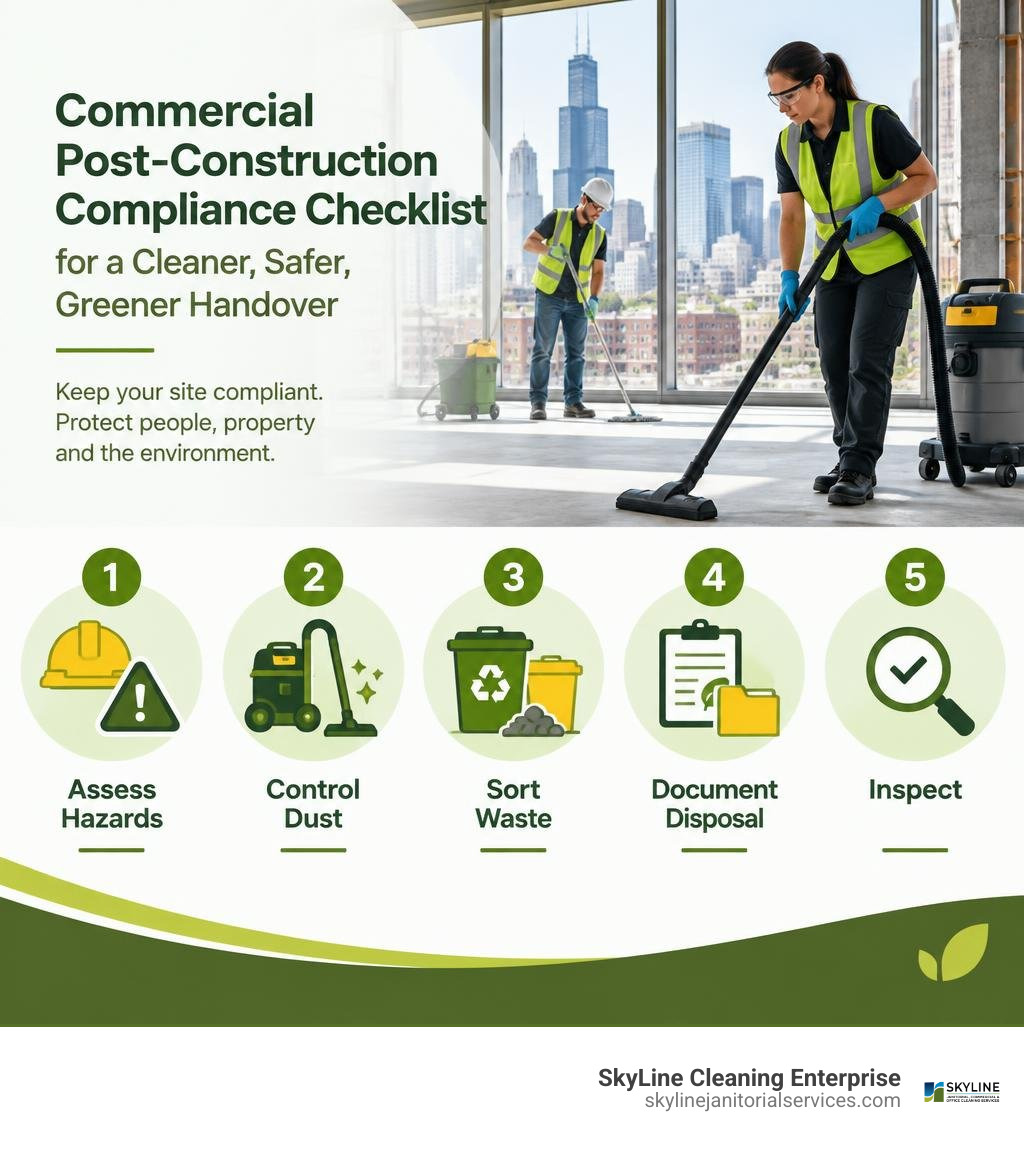
Helpful turnover resources for commercial facility managers:
- Preparing for corporate office post-construction turnover
- Managing post-construction punch list cleaning in Chicago
- Complete guide to Chicago post-construction cleaning
What Defines EPA-Compliant Post-Construction Cleaning for Chicago Commercial Sites?
When commercial builders wrap up a project in Chicagoland, handing over a pristine facility involves far more than sweeping drywall dust. Post-construction remediation must align with rigorous federal environmental benchmarks, the Clean Air Act, and strict local municipal standards. An effective approach to compliance standards ensures that dust control, runoff prevention, and surface sanitization satisfy both state and municipal regulations. For facility managers in Arlington Heights, Northbrook, Elk Grove Village, and downtown Chicago, this coordination is what separates a safe handover from a costly delay.

Federal standards establish clear rules for worker protection, particulate containment, and chemical application. For commercial facilities, educational spaces, and medical offices, meeting these requirements is vital. Overlooking them can trigger fines, fail safety audits, and delay the issuance of occupancy certificates. That is why experienced post-construction crews treat compliance as a working checklist rather than an afterthought.
Federal EPA vs. Chicago Municipal Environmental Regulations
Navigating compliance in our area requires coordinating federal rules with Cook County and municipal ordinances. The Clean Water Act mandates that wash water, paint residues, and slurry never enter storm sewers. A single rinse-out near a curb can become a regulatory problem if runoff reaches a storm drain, so crews must plan containment before wet work begins.
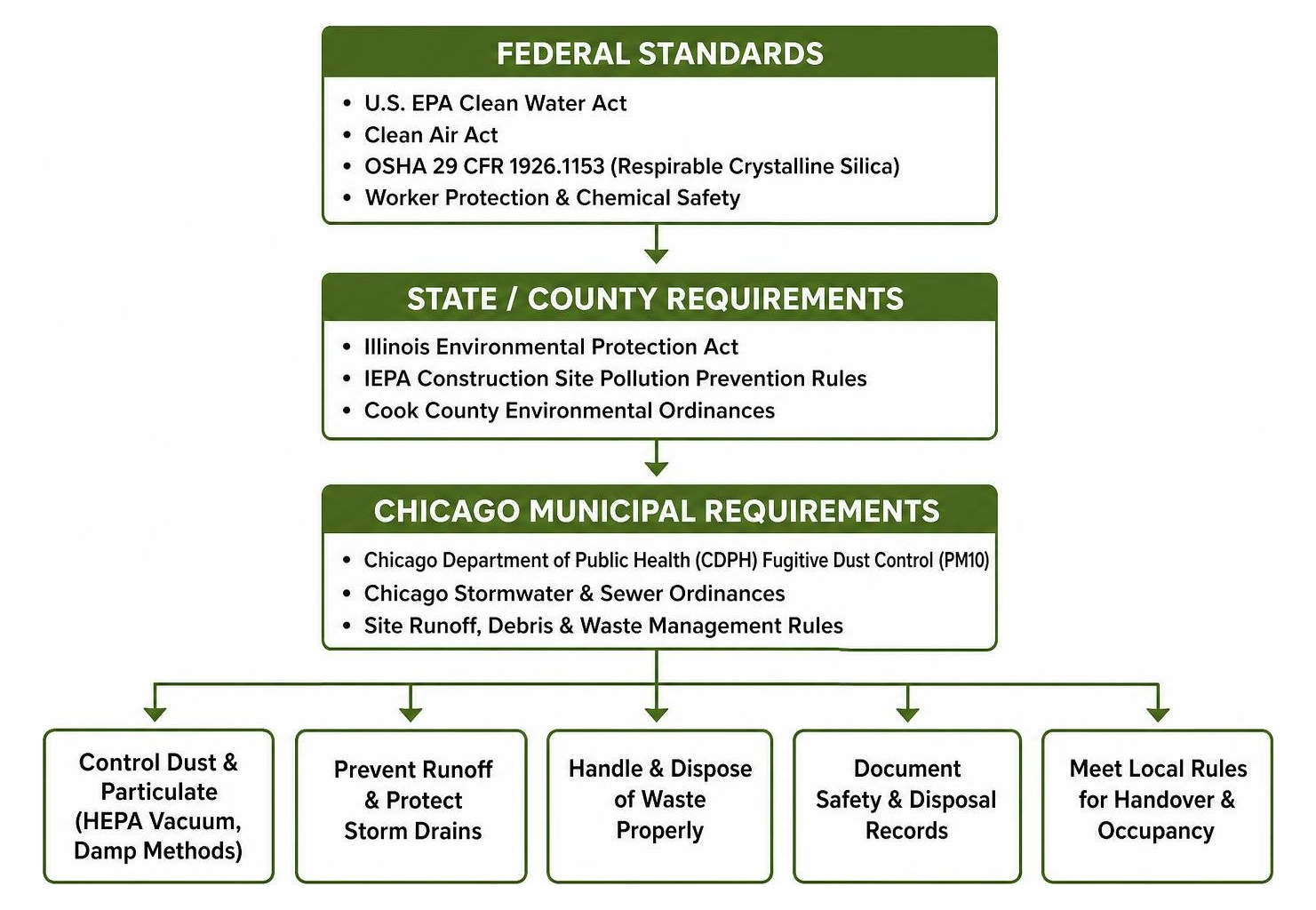
At the municipal level, the Chicago Department of Public Health (CDPH) enforces stringent fugitive dust control rules, especially regarding airborne particulate matter (PM10). Surrounding suburban municipalities, including Glenview, IL, Northbrook, and Elk Grove Village, have local environmental codes that regulate commercial runoff, dumpster placement, and outdoor equipment washing. Post-construction crews must understand these overlapping jurisdictions to keep the entire job site fully compliant, from the loading dock to the top-floor mechanical room.
Critical Standards for EPA-Compliant Post-Construction Cleanup
Meeting the standards that post-construction cleaning and EPA-compliant cleaning in Chicago commercial properties require demands strict adherence to health and safety codes. Respirable crystalline silica, governed by OSHA 29 CFR 1926.1153, presents serious health risks if dry-swept. Cleaning teams must use wet methods and industrial HEPA vacuum systems to prevent hazardous dust from becoming airborne. In enclosed commercial interiors, this is not a preference; it is a worker-safety and occupancy requirement.
Understanding general commercial construction project requirements ensures that teams safely remove construction residues, mortar haze, adhesives, and paint overspray without releasing high volatile organic compound (VOC) emissions into enclosed building interiors. For schools, medical offices, and corporate headquarters, controlling those emissions during final cleaning supports healthier indoor air from the first day of occupancy.
Step-by-Step Protocols for EPA-Compliant Post-Construction Cleanup
A compliant commercial turnover follows a structured, multi-phase process. Rather than treating cleanup as a single pass, we deploy systematic containment, rough clearing, detail extraction, and final surface treatment to ensure complete safety before tenant handover. This phased approach also creates a clear record of what was done, where, and in what order, which matters when facility managers need to document compliance for ownership or regulatory review.
| Phase | Core Objective | EPA & OSHA Compliance Measure |
|---|---|---|
| Phase 1: Rough Clean | Debris removal, large trash sorting | Segregated dumpster disposal, dry sweeping prohibited |
| Phase 2: Deep HEPA Clean | Fine particulate & silica dust removal | True HEPA extraction (0.3 µm capture), wet wiping |
| Phase 3: Final Detail | High-touch sanitation, floor refinishing | Low-VOC neutralizers, EPA-registered disinfectants |
Executing a thorough post-construction cleanup requires structured protocols that prevent cross-contamination across newly renovated spaces. In multi-tenant buildings, that means protecting occupied suites from dust migration while work continues elsewhere.
Stage 1 & 2: Hazardous Dust Control and HEPA Extraction
The initial stages focus on containment and particulate control. Cleaning teams establish negative pressure barriers when necessary to prevent silica and drywall dust from migrating into operational HVAC ducts or occupied suites. In Chicago commercial buildings with shared air handling, this step is especially important because dust can travel far beyond the immediate work area.
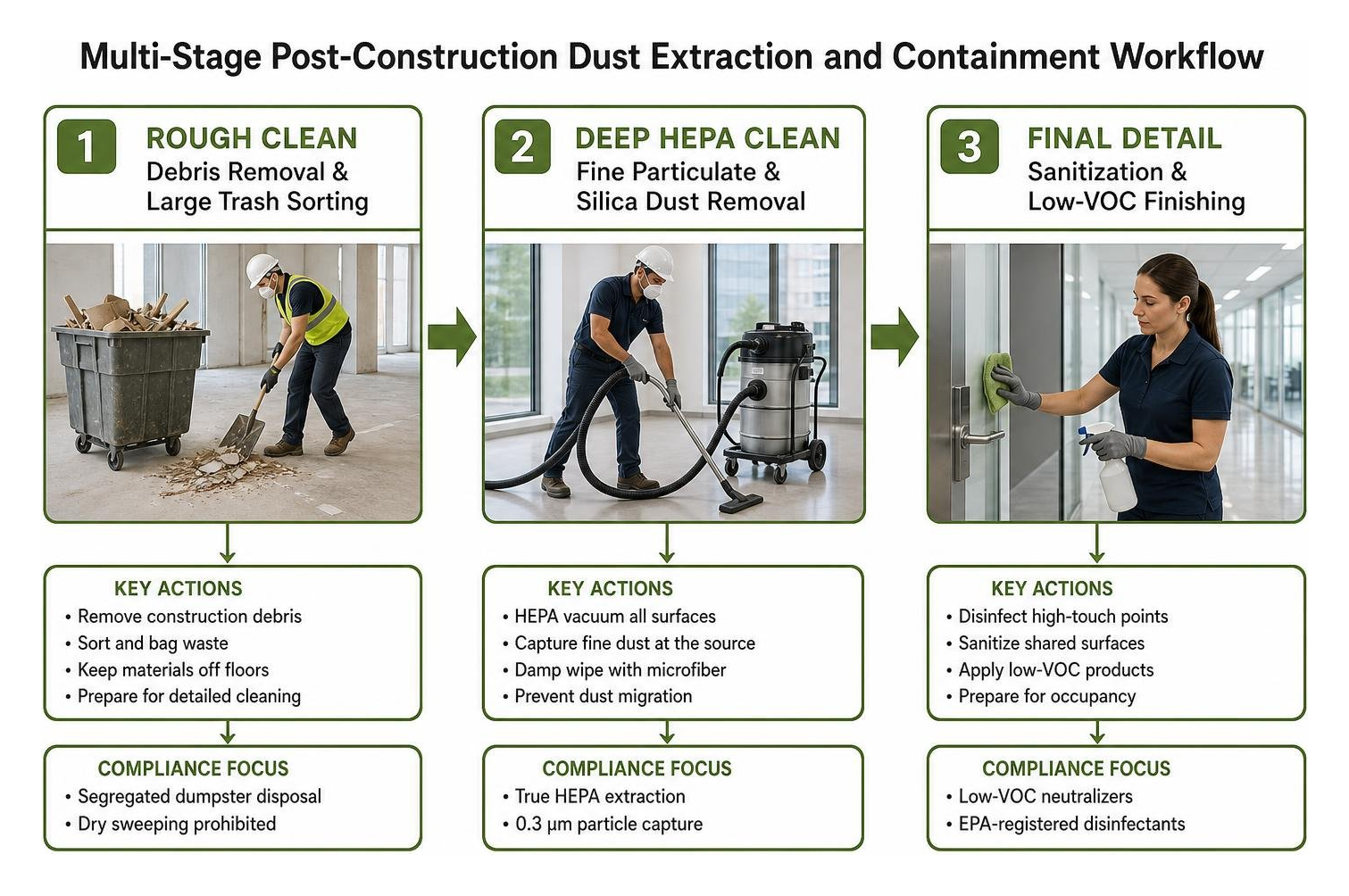
Our crews use true HEPA-filtered extraction equipment that captures 99.97% of particles down to 0.3 microns. By pairing HEPA extraction with damp microfiber wiping techniques, fine airborne dust is captured at the source rather than recirculated through the air. This combination is the practical foundation of compliant post-construction cleaning, and it is what keeps respirable silica out of the breathing zone for workers and future occupants alike.
Stage 3: Surface Sanitization and Low-VOC Finishing for Chicago Facilities
The final stage prepares commercial spaces for daily occupancy. Crews perform high-touch point disinfection and sanitization across door handles, light switches, elevator buttons, handrails, and shared surfaces. For offices, clinics, and schools, this step supports the sanitation expectations that facility managers must meet before staff and visitors return.
Floors receive specific restorative care based on their material. Commercial VCT requires professional stripping, sealing, and waxing to restore a durable, protective gloss, while commercial carpets require deep extraction to pull out tracked-in dust. Restrooms receive complete sanitation to eliminate grime and prep plumbing fixtures for immediate staff and visitor use. Throughout this stage, crews select low-VOC finishing products and EPA-registered disinfectants so that the final clean does not introduce unnecessary chemical loading into freshly prepared interiors.
Waste Disposal, Hazardous Material Handling, and Compliance Documentation
Under the Resource Conservation and Recovery Act (RCRA), commercial facilities must responsibly segregate, handle, and document all waste generated during post-construction operations. Construction debris cannot simply be thrown into a standard general waste bin if it contains regulated materials. In practice, that means separate containers for general debris, recyclable metals, and any material that may carry hazardous residues, with clear labeling and controlled access.
Facility managers must ensure that cleaning partners maintain up-to-date Safety Data Sheets (SDS) for all cleaning formulations brought on-site. Those sheets are not just paperwork; they are the reference point for safe handling, spill response, and disposal decisions. For more comprehensive insights into turnover management, review our facility management post-construction cleanup guide. A dependable cleaning partner will also keep disposal manifests and chain-of-custody records so that ownership can demonstrate compliance long after the final walkthrough.
How Facility Managers Can Verify Contractor Compliance and Avoid Pitfalls
Hiring an underqualified cleaning crew poses significant operational and legal risks. When non-compliant teams use improper disposal methods or dry-sweep hazardous particulates, facility managers can face regulatory fines, failed building inspections, and expensive indoor air remediations. The problem often shows up after handover, when dust reappears in ductwork or a disposal record is missing.
To ensure proper handover standards, managers should consult our post-build corporate handover guide and confirm that their cleaning vendor provides:
- Complete Certificates of Insurance (General Liability, Workers’ Compensation, and Auto Insurance).
- Verified employee safety training on OSHA silica dust and hazard communication.
- Dedicated on-site supervisory oversight on every shift to verify execution.
- Professional-grade equipment, commercial HEPA vacuums, and proper floor burnishers.
- Written quality logs that track particulate control, waste segregation, and final surface treatment.
A qualified post-construction cleaning partner should be able to walk a facility manager through each of these items before work begins. If the answers are vague or the documentation is slow to appear, that is a warning sign for the entire handover schedule.
Frequently Asked Questions About EPA-Compliant Post-Construction Cleaning
What documentation proves a post-construction cleaning was EPA compliant?
Documentation includes verified disposal manifests, active Safety Data Sheets (SDS) for all chemical solutions, equipment maintenance records showing true HEPA filter ratings, and supervisor quality logs tracking particulate control. Air quality clearance reports may also be required for sensitive occupancies such as medical offices or schools.
How does post-construction cleaning compliance differ for commercial and industrial sites?
Commercial projects focus heavily on indoor air quality, low-VOC finishes, restroom sanitation, and carpet extraction for office occupancy. Industrial turnarounds often require specialized degreasing, heavy particulate removal over broad warehouse flooring, and containment of manufacturing-related residues under industrial waste codes. The core compliance principles are similar, but the waste streams and surface treatments differ significantly.
What are the legal risks of non-compliant post-construction cleaning in Chicago?
Non-compliance can result in severe fines from the EPA or CDPH, stop-work orders, delayed occupancy permits, and potential liability claims from tenants exposed to airborne silica or chemical fumes. Municipal citations can also follow if wash water or debris reaches storm drains, so runoff control must be part of every cleanup plan.
Conclusion
Achieving a clean, safe, and compliant commercial space requires experienced management, strict dust containment, and thorough waste documentation. For facility managers and property managers across Chicagoland, EPA-compliant post-construction cleaning standards are not a single certificate; they are the result of coordinated federal, state, and municipal compliance applied consistently from rough clean to final detail.
SkyLine Cleaning Enterprise is a women-owned and family-owned commercial cleaning company founded in 2007. Based in Arlington Heights, IL, we serve commercial facilities across Cook County and Lake County within a 40-mile radius—including Chicago, Des Plaines, Mount Prospect, Buffalo Grove, and Glenview.
With nearly 20 years of experience, our dependable teams provide expert commercial janitorial services, post-construction cleanup, VCT floor strip and waxing, and commercial carpet cleaning. Every facility receives an individualized cleaning plan backed by dedicated supervisory oversight, fully insured crews, and our reliable, old-school work ethic. As an added benefit, new annual contract clients receive a complimentary deep cleaning on their first day of service, deploying an extra crew to establish the highest standard of clean from day one. Schedule our post-construction cleanup services today to ensure your facility opens safely, cleanly, and on schedule.