
Medical Research Facility Cleaning: Compliance Guidelines for Controlled Environments
Regulatory Frameworks and Compliance Standards for Research Labs
Medical research facilities balance biological safety, chemical hazard management, and strict contamination limits. When cleaning teams service these spaces, standard commercial practices are not enough. Cleaning routines must align with federal safety rules and specific laboratory contamination thresholds.
Several major compliance structures govern sanitation in these environments:
- Occupational Safety and Health Administration (OSHA): Establishes workplace safety standards, particularly the Bloodborne Pathogens Standard (29 CFR 1910.1030) and Hazard Communication Standard (29 CFR 1910.1200). These require specialized personal protective equipment (PPE), hazard communication training, and clear chemical labeling.
- Environmental Protection Agency (EPA): Regulates antimicrobial products. Facilities rely on EPA-registered disinfectants (including List N for viral pathogens) to ensure that chemicals achieve proven log reductions against targeted microorganisms without damaging surrounding equipment.
- Control of Substances Hazardous to Health (COSHH) & Good Laboratory/Manufacturing Practice (GLP/GMP): Mandate thorough risk assessments for chemical exposures and enforce cleanliness standards that preserve product and trial integrity.
- ISO 14644 Standards: Specify airborne particulate limits across cleanroom classes, determining the allowable particle counts and cleaning frequencies for controlled research rooms.
Understanding how these regulations fit together is essential. You can consult our practical guide to compliance standards to see how commercial cleaning plans align with regulatory requirements across regulated sectors.
Recent studies highlight environmental cleaning as a core pillar of healthcare and research safety. A global expert consensus identified standardized protocols and structured systems as vital priorities for maintaining safe operational environments. Federal research campuses, such as the NIH Clinical Center in Bethesda, enforce these rules through strict contract requirements, setting firm benchmarks for environmental and janitorial operations under NAICS 561720 NIH Lab and Cleanroom Cleaning RFP Guide for BSCs | Opora.
Cleanroom Classifications and Biosafety Levels (BSL-1 to BSL-3)
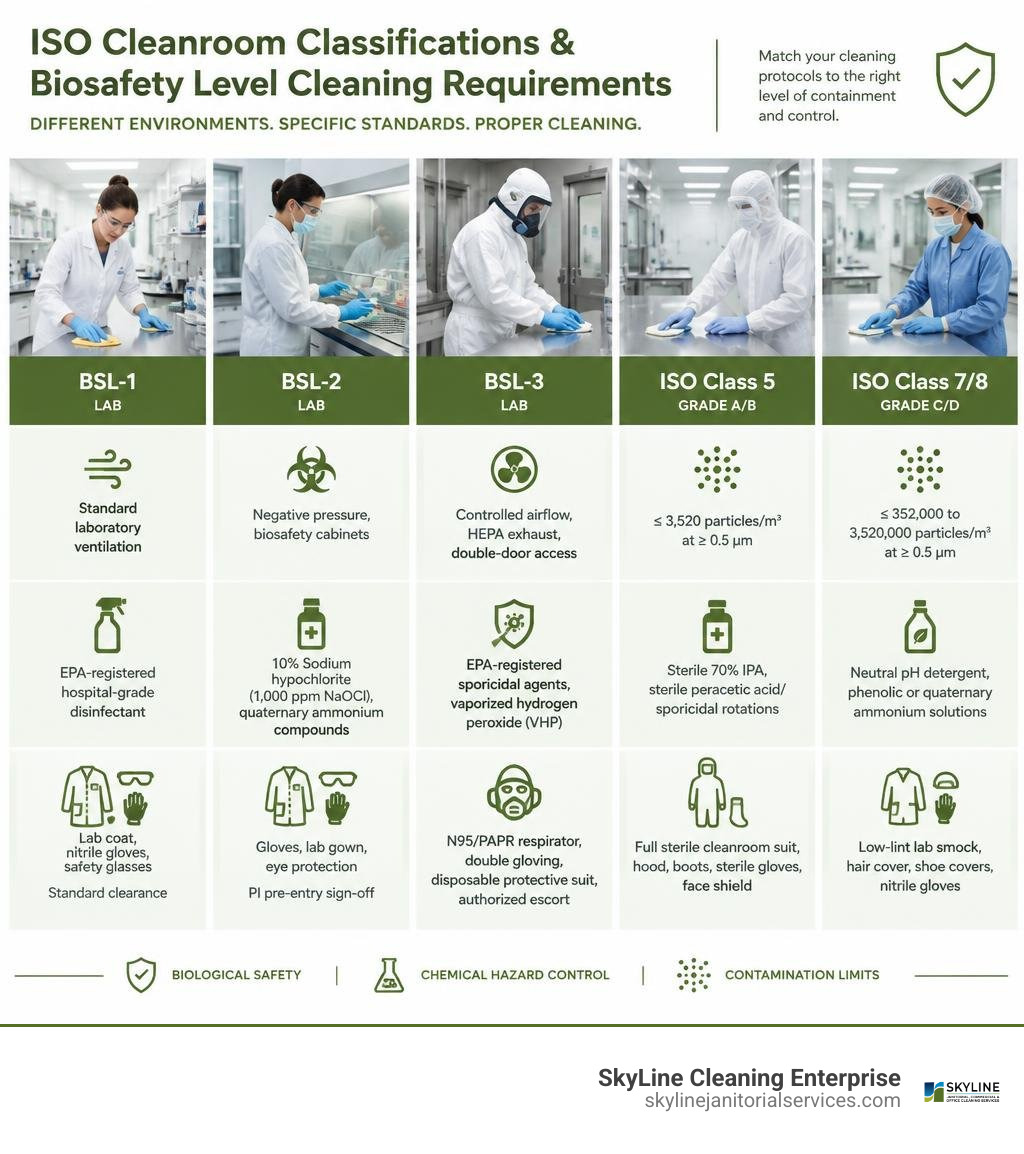
Cleaning procedures must match the specific classification of the cleanroom or containment level of the lab. A standard Grade A cleanroom used for aseptic processing operates under ISO Class 5 standards both at rest and during operation, requiring strict particulate control, low-lint wipes, and dedicated cleaning equipment.
Biosafety levels address biological risks rather than just particulate counts:
| Environment / Tier | Air Quality / Containment Standard | Core Disinfectants Used | PPE & Entry Clearance Protocols |
|---|---|---|---|
| BSL-1 Lab | Standard laboratory ventilation | EPA-registered hospital-grade disinfectant | Lab coat, nitrile gloves, safety glasses; standard laboratory clearance |
| BSL-2 Lab | Negative pressure, biosafety cabinets | 10% Sodium hypochlorite (1,000 ppm NaOCl), quaternary ammonium compounds | Gloves, lab gown, eye protection; Principal Investigator (PI) pre-entry sign-off |
| BSL-3 Lab | Controlled airflow, HEPA exhaust, double-door access | EPA-registered sporicidal agents, vaporized hydrogen peroxide (VHP) | N95/PAPR respirator, double gloving, disposable protective suit, authorized escort |
| ISO Class 5 (Grade A/B) | No more than 3,520 particles per cubic meter at 0.5 microns or larger | Sterile 70% Isopropanol (IPA), sterile peracetic acid/sporicidal rotations | Full sterile cleanroom suit, hood, boots, sterile gloves, face shield |
| ISO Class 7/8 (Grade C/D) | 352,000 to 3,520,000 particles per cubic meter at 0.5 microns or larger | Neutral pH detergent, phenolic or quaternary ammonium solutions | Low-lint lab smock, hair cover, shoe covers, nitrile gloves |
Establishing Rigorous Medical Research Facility Cleaning Protocols
Consistency is the foundation of contamination control. When handling controlled research environments across Cook County and Lake County, IL, cleaning crews follow strict physical motion patterns and workflow directions.
Cleaning starts at the cleanest areas and moves toward dirtier perimeters, from top to bottom, and from inner zones toward the exit door. This structured workflow prevents contaminants from transferring from high-traffic doorways into sterile interior stations.
High-touch areas—such as biosafety cabinet exterior ledges, centrifuge lids, incubators, door pulls, and service valve handles—require systematic wiping rather than random spot-cleaning. Teams dedicated to specialized medical cleaning use folded microfiber cloths, turning to a clean surface with each pass to prevent redepositing soils on research equipment.
Zoning Strategies for Medical Research Facility Cleaning
Every medical research campus has distinct functional zones that require dedicated cleaning protocols:
- Wet Laboratories: Wet research benches contain chemical and biological reagents. Cleaning staff focus on perimeter floors, exterior utility hookups, and waste receptacles, leaving active benches and fume hoods to lab personnel to protect research setups.
- Dry Analytical Labs: Housing mass spectrometers, microscopes, and servers, these areas require anti-static wiping and dry or damp microfiber dusting to prevent moisture damage to delicate electronics.
- Vivariums: Animal research spaces demand non-irritating, residue-free sanitizers that eliminate odor and pathogen risks without introducing aerosolized chemicals that could alter animal physiology.
- Clinical Trial Spaces: Where patients interact directly with research protocols, routines match hospital-grade cleanliness, combining frequent disinfection of high-touch furniture with specialized floor care SOP-CRF-4 V4 – Cleaning Procedures within the Clinical Research Facility and Health Sciences Building.
Laboratory-Grade Disinfectant Selection and Chemical Compatibility
Choosing the correct cleaning chemistry requires balancing pathogen reduction against equipment preservation and researcher safety:
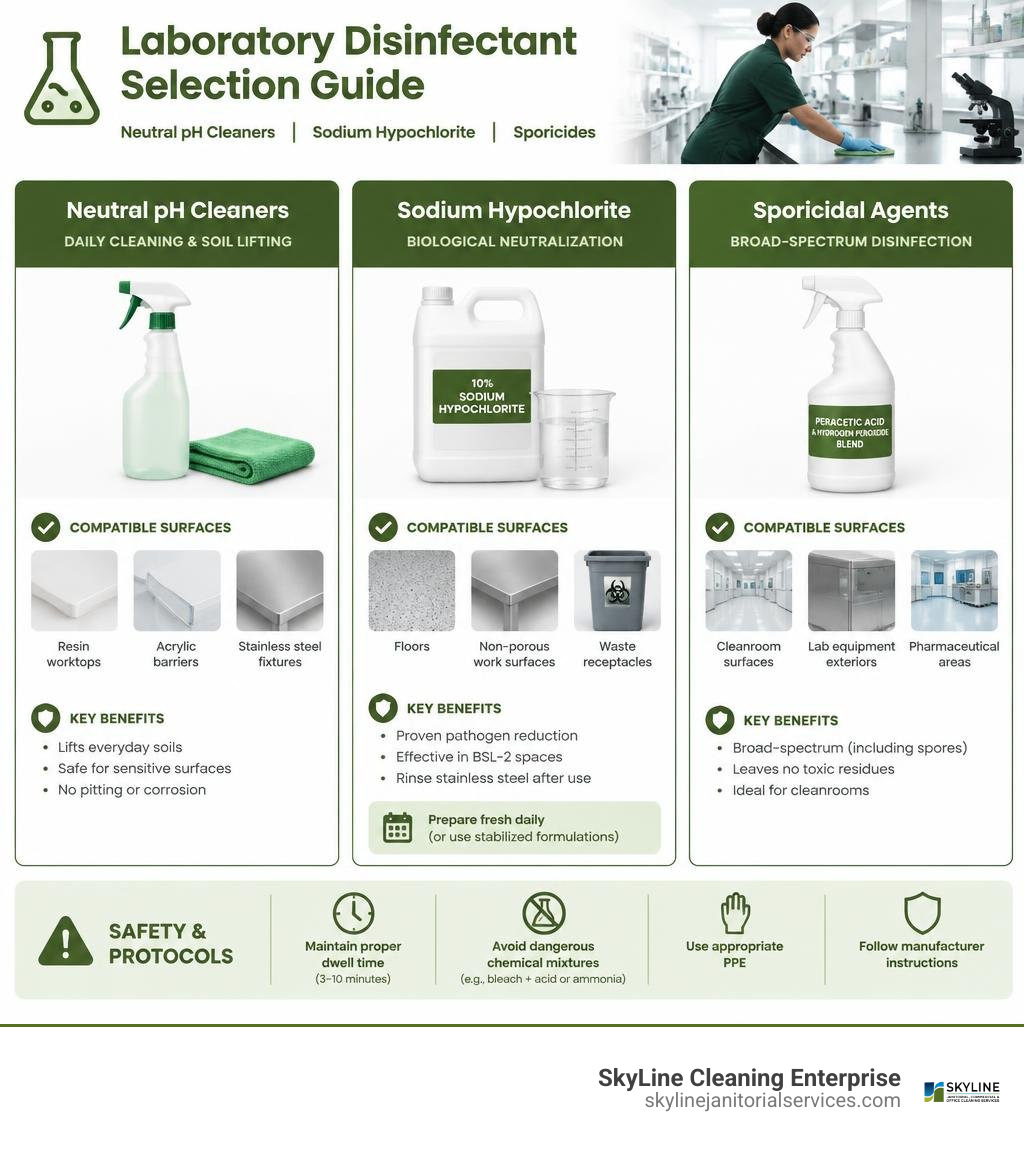
- Neutral pH Cleaners: Used for daily soil lifting on sensitive resin worktops, acrylic barriers, and stainless steel fixtures without causing pitting or corrosion.
- 10% Sodium Hypochlorite Solutions: A proven standard for biological neutralization in BSL-2 spaces. It must be prepared fresh daily (or used via stabilized formulations) to maintain available chlorine levels, followed by a purified water rinse on stainless steel to prevent salt corrosion.
- Peracetic Acid and Hydrogen Peroxide Blends: Broad-spectrum sporicidal agents that leave no toxic residues, making them ideal for pharmaceutical and biological cleanrooms.
- Dwell Times and Incompatibility Controls: Disinfectants must remain visibly wet on surfaces for their complete, manufacturer-tested dwell time (typically 3 to 10 minutes). Crews must prevent dangerous chemical interactions—such as mixing bleach with acid-based cleaners or ammonia—through strict protocol management and targeted disinfection and sanitization services.
High-Containment Decontamination and Biohazard Management
Higher-containment spaces, including BSL-2 and BSL-3 labs, require facility-approved procedures under OSHA Bloodborne Pathogen rules. Facility managers should coordinate any work involving biological hazards, aerosol risks, or specialized respiratory protection with authorized biosafety personnel and qualified decontamination providers.
Handling bodily fluids or high-titer biological materials requires a structured cleanup process:
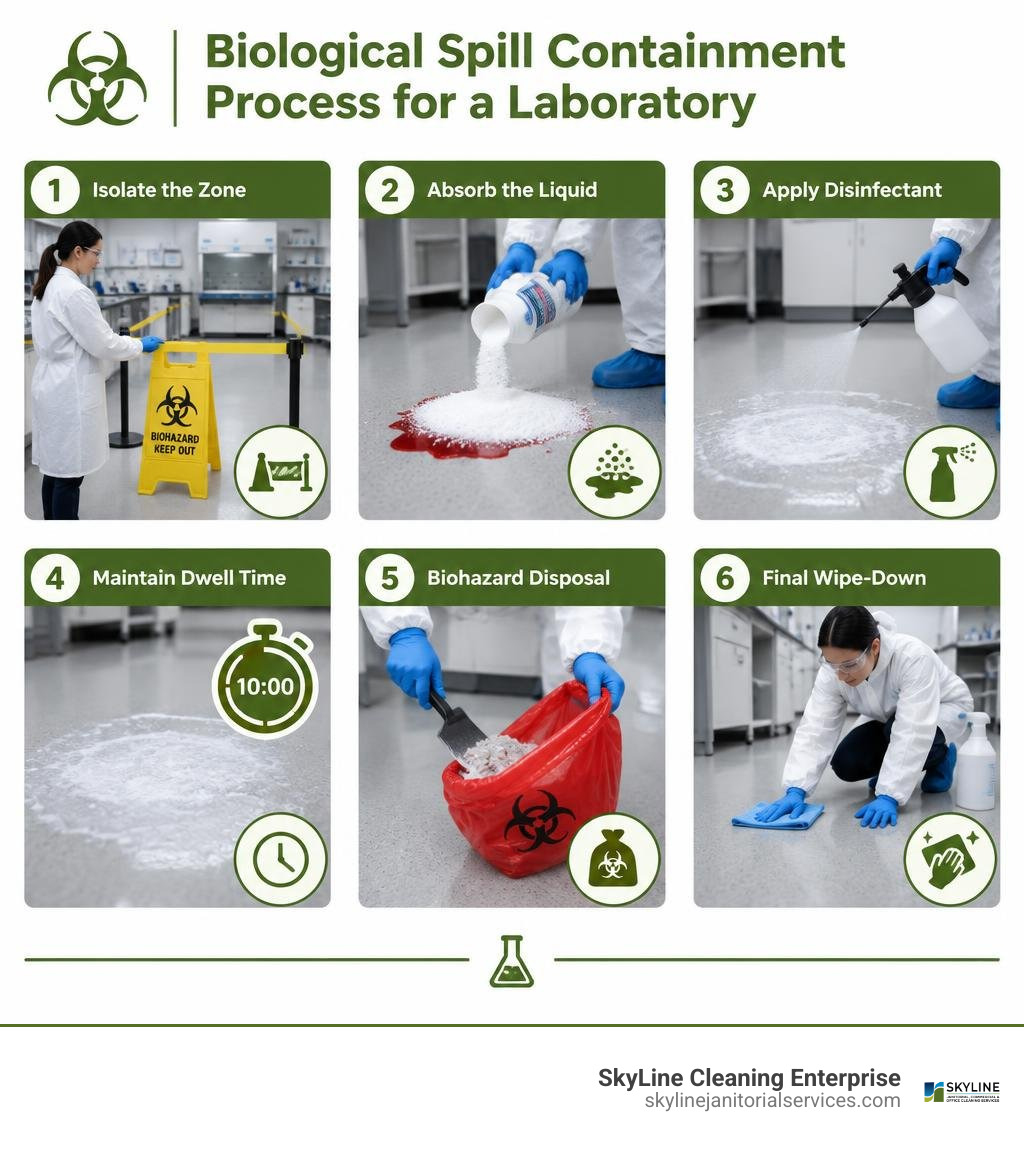
- Isolate the Zone: Alert researchers, post warning signage, and secure the perimeter.
- Absorb the Liquid: Apply an absorbent gel-forming powder over the liquid to contain spread and limit aerosolization.
- Apply Disinfectant: Saturate the area using an EPA-registered intermediate-to-high level disinfectant, working from the outside of the spill inward.
- Maintain Dwell Time: Keep the surface wet for the full validated contact time (up to 10 minutes).
- Biohazard Disposal: Collect the solidified material using disposable scrapers and place all waste directly into red biohazard bags for autoclaving.
- Terminal Wipe-Down: Complete a final wipe-down of adjacent vertical and horizontal surfaces according to the facility’s approved infection control cleaning procedure.
Specialized facilities, such as the Frederick National Laboratory’s ATRF Virus Production Facility, demonstrate the rigor required in high-containment spaces Cleaning and Disinfection of the ATRF Virus Production Facility. There, facilities rotate monthly floor sanitization using sporicides such as Decon-Spore, maintain 10-minute wet dwell times, and post safety caution signs for at least 24 hours while air handling systems cycle.
Specialized Deep Cleaning and Periodic Reset Schedules
Daily maintenance keeps baseline bioburdens low, but facilities also need scheduled deep cleans during shutdowns, research transitions, or following maintenance work.
These deep cleaning programs include:
- Sporicidal Floor Rotations: Switching out quaternary disinfectants once a month for a concentrated sporicidal application to eliminate resistant bacterial endospores.
- Facility-Approved Airflow Area Care: Clean only accessible exterior surfaces around supply and return air louvers as directed by the facility. Do not spray into HEPA filters or service ventilation components, as those tasks require qualified maintenance personnel.
- Floor Waxing and Resilient Tile Care: For non-cleanroom corridors, offices, and sample drop-off areas, periodic VCT strip and wax routines using durable floor finishes keep surfaces non-porous and easier to sanitize.
Quality Assurance, Personnel Training, and Audit Readiness
Our nearly two decades of commercial cleaning experience in Cook County and Lake County show that a cleaning protocol is only as good as its execution and documentation. Facility managers at medical centers in Arlington Heights, Northbrook, and Chicago face regular inspections from safety committees, the FDA, and local health boards.
Training must cover standard janitorial duties alongside biosafety containment levels, laboratory safety signs, gowning sequences, and emergency spill response. Clear division of duties is critical: domestic cleaning staff manage floors, hand basins, trash receptacles, and facility fixtures, while research teams handle their own benchtop apparatus, reagent spills, and active experiment hardware.
Our detailed commercial medical cleaning guide outlines how structured training programs help maintenance teams work effectively alongside lab researchers.
Documentation and Auditing in Medical Research Facility Cleaning
Facilities use several objective validation methods to verify cleaning quality:
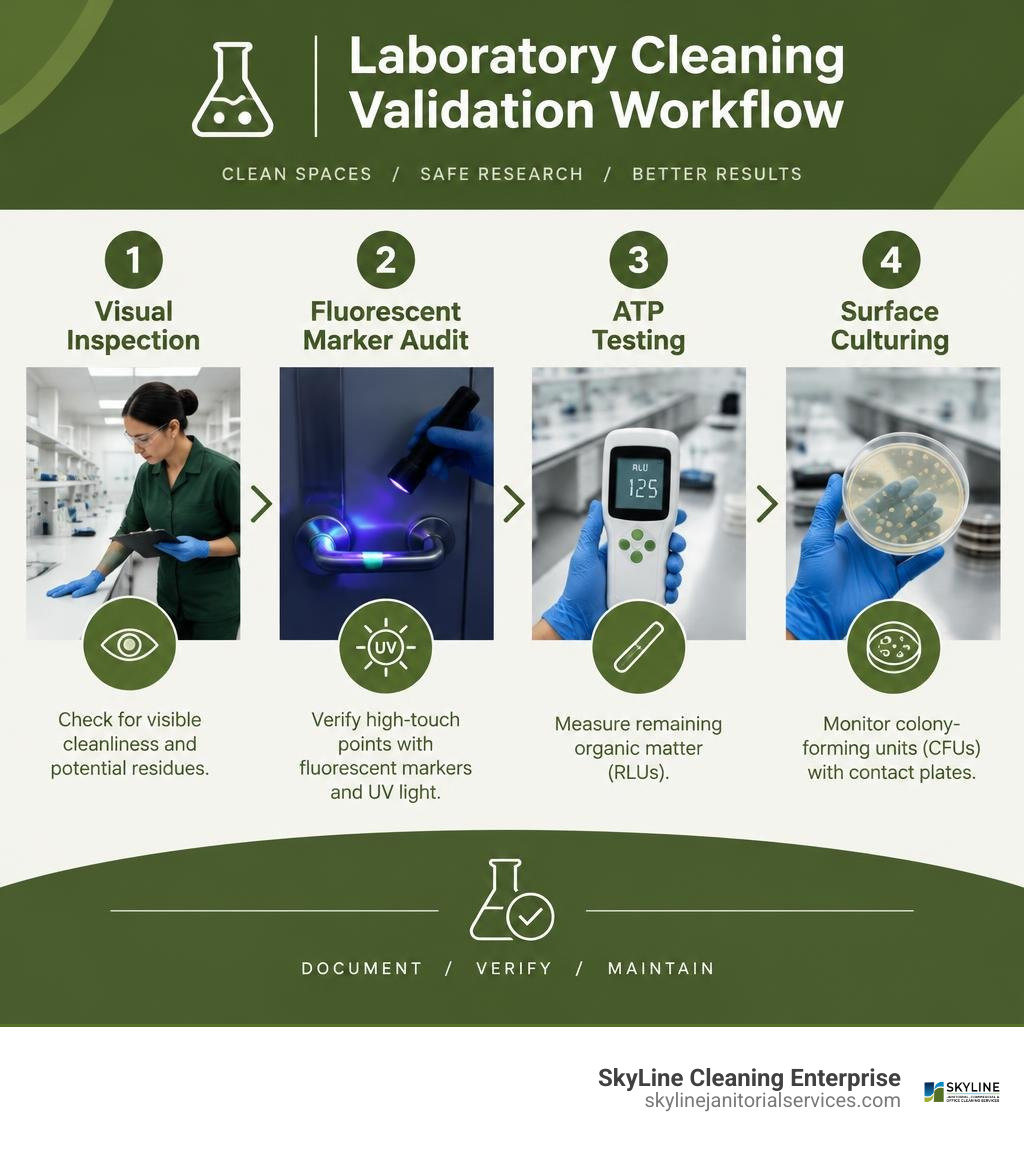
- ATP Bioluminescence Testing: Swabbing surfaces before and after cleaning gives an immediate reading of remaining organic matter (measured in Relative Light Units, or RLUs), confirming soil removal.
- Fluorescent Marker Audits: Transparent gel markers applied to high-touch points before a shift are checked with UV light afterward to verify that target fixtures were wiped down.
- Environmental Surface Culturing: Conducted by internal QA teams using contact plates to monitor colony-forming units (CFUs) within cleanrooms and biosafety spaces.
- Comprehensive Cleaning Logs: Every shift logs dates, start/stop times, specific chemical lot numbers, dilutions, and staff signatures. These detailed records maintain audit readiness for external regulators and institutional safety boards.
Frequently Asked Questions About Laboratory Cleaning
How often should high-touch surfaces be disinfected in medical research facilities?
High-touch points in high-activity laboratories and clinical trial spaces should be cleaned and disinfected at least twice daily and whenever visibly soiled. Following CDC healthcare environmental guidelines, staff should use fresh, pre-treated microfiber cloths for each cleaning pass, avoiding double-dipping cloths into clean disinfectant solution. Low-touch surfaces, such as secondary walls and windowsills, are typically damp-dusted weekly using purified water or neutral cleaners.
What is the proper procedure for biological fluid spills in a lab setting?
First, seal off the area and notify surrounding personnel. Responders wear full PPE (gloves, fluid-resistant gown, eye protection, and respiratory protection if aerosol risks exist). Cover the spill with an absorbent gel-forming powder from a dedicated biological spill kit to lock the liquid in place. Apply an approved intermediate-to-high level EPA disinfectant over the gelled mass, observe the required dwell time (up to 10 minutes), scoop the waste into marked biohazard bins for autoclaving, and finish with a thorough disinfectant wipe of surrounding floors and baseboards.
What qualifications are required for personnel cleaning BSL-2 and BSL-3 labs?
Staff cleaning BSL-2 and BSL-3 areas must complete formal OSHA Bloodborne Pathogens training, pass facility biosafety clearances, undergo chemical hazard communication training, and receive respiratory fit testing (for N95 or PAPR units). In BSL-3 spaces, cleaning crews work under the direct supervision of an authorized escort or safety officer, with verified background checks and documented backup staff to maintain coverage during all operational cycles.
Partner with Experienced Commercial Cleaning Professionals
Maintaining a medical research facility requires steady oversight, dependable technicians, and cleaning programs tailored to every room’s safety profile. SkyLine Cleaning Enterprise is a women-owned and family-owned commercial cleaning company based in Arlington Heights, IL. Since 2007, our team has delivered dependable janitorial services, VCT floor waxing, and commercial carpet cleaning for commercial facilities, offices, and medical research campuses throughout Cook County and Lake County.
Whether you operate a corporate research hub in Buffalo Grove, an analytical center in Elk Grove Village, or a clinical facility in Des Plaines, Glenview, or Chicago, our approach is built on hands-on supervisory oversight, dependable service, and custom cleaning plans for your facility. We bring our own professional equipment and supplies, carry complete insurance coverage (General Liability, Workers’ Comp, and Auto), and bring an experienced work ethic to every shift.
To help you establish a strong baseline of cleanliness from day one, we often provide new commercial clients with a complimentary deep cleaning on the first day of service, bringing an extra crew to prepare your space for ongoing maintenance.
Contact our team today to discuss an individualized plan for your facility with our reliable commercial cleaning services near Chicago.
References
Gon G, Dramowski A, Hornsey E, Graham W, Fardousi N, Aiken A, Allegranzi B, Anderson D, Bartram J, Bhattacharya S, Brogan J, Caluwaerts A, Padoveze MC, Damani N, Dancer S, Deeves M, Denny L, Feasey N, Hall L, Hopman J, Chettry LK, Kiernan M, Kilpatrick C, Mehtar S, Moe C, Nurse-Findlay S, Ogunsola F, Okwor T, Pascual B, Patrick M, Pearse O, Peters A, Pittet D, Storr J, Tomczyk S, Weiser TG, Yakubu H. “Research priorities to strengthen environmental cleaning in healthcare facilities: the CLEAN Group Consensus..” Antimicrobial resistance and infection control, 2024. PMID 39334226.